The buyer's checklist for AI governance platforms
The complete evaluation framework for enterprise buyers
AI governance tools: the 49 capabilities that separate platforms from checklists
AI governance tools are now a procurement category, not an experiment. With the EU AI Act's high-risk system deadline hitting in August 2026 and fines reaching EUR 35 million or 7% of global turnover, enterprises need platforms that can withstand regulatory scrutiny, not slide decks that describe good intentions.
But the market is crowded and the language is vague. Every vendor claims to cover compliance, risk, and monitoring. Distinguishing a genuine AI governance platform from a repackaged GRC tool or a bolted-on feature requires a structured evaluation framework.
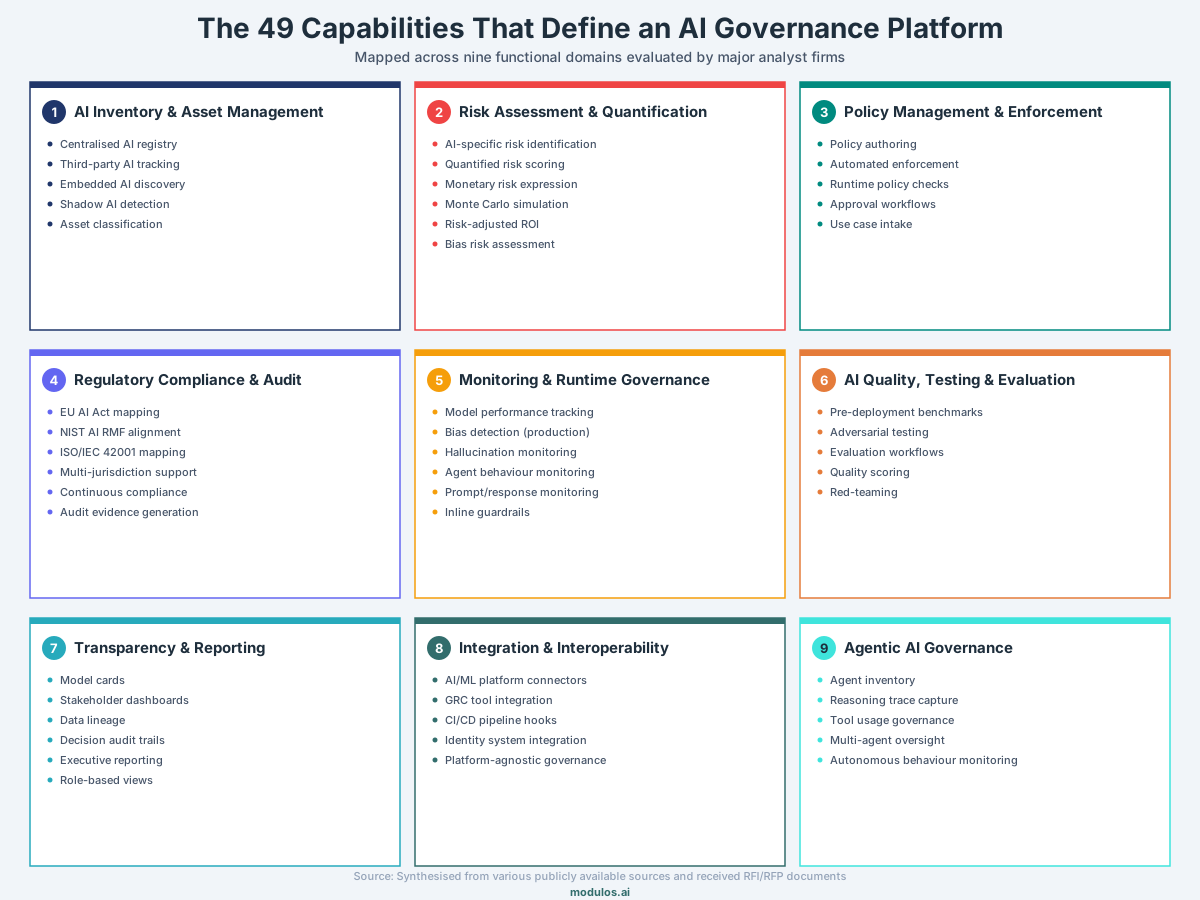
We built one. We synthesised the evaluation criteria from the major analyst reports on AI governance platforms, the capability requirements appearing in enterprise RFIs and RFPs, and the scoring frameworks procurement teams are using to shortlist vendors. The result is 49 distinct capabilities across nine functional domains that collectively define what "AI governance tool" means in 2026.
This is the RFI/RFP checklist that analyst evaluations, enterprise procurement processes, and RFP scoring committees are converging around, whether vendors realise it or not.
What are AI governance tools?
AI governance tools are software platforms that help organisations manage the risks, compliance obligations, and operational oversight requirements that come with deploying AI systems. They sit between the teams building AI and the regulators, auditors, and boards who need assurance that those systems are safe, fair, and legally compliant.
Unlike traditional GRC platforms that were built for IT compliance and data privacy, purpose-built AI governance tools understand AI-specific risks: model drift, hallucination, bias in automated decisions, shadow AI proliferation, and the emerging challenge of autonomous agents operating without human oversight.
The best AI governance tools cover the full lifecycle, from discovering what AI exists in the organisation, through assessing and mitigating risk, to producing audit-ready evidence for regulators and certification bodies.
The nine domains that define AI governance tools
The major analyst firms, enterprise RFIs, and procurement scoring frameworks don't use identical terminology, but they converge around the same nine functional areas. This convergence reflects how CISOs, Chief AI Officers, and governance leads actually think about the problem.
Here are all 49 capabilities, numbered across the nine domains.
Domain 1: AI inventory and asset management
Every evaluation framework expects AI governance tools to answer a basic question first: do you know what AI you have?
- Centralised registry of all internal AI systems
- Inventory of third-party and vendor AI
- Detection of embedded AI in existing SaaS tools
- Shadow AI discovery across the enterprise
- Automated AI asset classification and tagging
- Ongoing inventory updates as new AI is deployed
Shadow AI is the capability that separates serious AI governance tools from basic registries. Research shows that the majority of AI tools in most enterprises operate without IT approval, and shadow AI breaches cost significantly more than standard incidents. If your governance tool relies on teams self-reporting their AI usage, your inventory is already incomplete.
Domain 2: Risk assessment and quantification
This is where the gap between purpose-built AI governance tools and generic GRC platforms becomes obvious.
- AI-specific risk identification (bias, hallucination, data leakage, prompt injection, model drift)
- Qualitative risk scoring per AI system
- Quantified monetary risk exposure in financial terms
- Expected loss calculations with confidence intervals
- Risk-adjusted ROI on mitigation options
- Portfolio-level risk aggregation across all AI systems
Most tools stop at capability 8, giving you a red/amber/green risk matrix and calling it done. But a CISO walking into a board meeting with traffic-light colours and no financial figures has nothing actionable to present. The shift from qualitative risk labels to quantified monetary exposure, showing expected losses in euros with confidence intervals and risk-adjusted ROI on mitigation, is the shift from governance as a compliance function to governance as a strategic asset.
Modulos uses a number of different methodologies to quantify AI risk in monetary terms. This is a core differentiator: boards and audit committees can evaluate AI risk the same way they evaluate financial, operational, or cyber risk.
Domain 3: Policy management and enforcement
- Policy authoring and documentation
- Automated policy enforcement at runtime
- Policy versioning and change tracking
- Role-based policy access and ownership
- Policy breach alerting and escalation workflows
The difference between having an AI policy and enforcing one is the difference between a document and a system. AI governance tools should automate enforcement so that policy violations trigger alerts and escalations, rather than waiting for the next quarterly review to discover a breach.
Domain 4: Regulatory compliance and audit readiness
This is where EU-focused AI governance tools need to prove their depth.
- Pre-built mapping to the EU AI Act
- Pre-built mapping to NIST AI RMF
- Pre-built mapping to ISO/IEC 42001
- Multi-framework shared controls (one action satisfies multiple frameworks)
- Automated audit evidence generation
- Continuous compliance monitoring, not point-in-time snapshots
- Regulator-ready documentation and reporting
Capability 21 is worth particular attention. Enterprises operating under the EU AI Act, ISO 42001, NIST AI RMF, and GDPR simultaneously are drowning in duplicate work if their platform treats each framework as a separate compliance silo. The best AI governance tools use a shared controls architecture: one control action, documented once, satisfies requirements across multiple frameworks simultaneously.
Modulos is Europe's first platform to meet the requirements of ISO 42001, independently evaluated by CertX. This is not just a product feature. It is a market credential that proves the platform meets the standard it helps clients implement.
Domain 5: Monitoring, observability, and runtime governance
- Model performance tracking in production
- Bias detection after deployment
- Hallucination monitoring for GenAI systems
- Data drift and model drift alerts
- AI agent behaviour monitoring in production
- Multi-agent interaction monitoring
Pre-deployment governance is necessary but insufficient. AI systems change behaviour in production as data distributions shift, user patterns evolve, and models degrade. AI governance tools must provide continuous runtime monitoring, not just a one-time conformity assessment before launch.
Domain 6: AI quality, testing, and evaluation
- Structured pre-deployment evaluation workflows
- Adversarial and red-team testing
- Benchmarking against defined quality thresholds
- Testing integrated into the governance process, not bolted on separately
Testing that lives outside the governance workflow creates gaps. When evaluation results don't automatically feed into risk assessments and compliance records, teams end up maintaining parallel systems and the audit trail breaks.
Domain 7: Transparency, explainability, and reporting
- Model cards and system documentation
- Plain-language explainability for non-technical stakeholders
- Role-based dashboards (CISO, CRO, board, legal)
- Data lineage tracking
- Decision audit trails
- Stakeholder-specific reporting templates
Different stakeholders need different views. A CISO needs risk exposure. A board member needs business impact. A regulator needs conformity evidence. AI governance tools that force everyone through the same dashboard fail at the reporting layer even if the underlying data is sound.
Domain 8: Integration and interoperability
- Integration with existing AI/ML infrastructure
- GRC tool connectors
- CI/CD pipeline integration
- Identity and access management integration
- API-based governance for AI built on any platform
- Support for on-premise, cloud, and hybrid deployments
European enterprises in regulated sectors (financial services, healthcare, critical infrastructure) often require on-premise or private cloud deployment for data residency reasons. AI governance tools that only offer public SaaS eliminate themselves from these evaluations before a demo is even scheduled. Modulos supports SaaS, private cloud, and on-premise deployment.
Domain 9: Agentic AI governance
This is where the market is headed, and where most AI governance tools have the biggest gap.
- Agent inventory and registration
- Reasoning trace capture and tool access governance
- Agent behaviour monitoring, multi-agent oversight, and human escalation controls
Industry projections estimate that 40% of enterprise applications will embed task-specific AI agents by the end of 2026, up from less than 5% in 2025. Yet only a fraction of companies have a mature governance model for autonomous AI. Agents pursue goals autonomously, access data, make decisions, and take actions across systems without constant human direction. Governing them requires capabilities that didn't exist two years ago: reasoning trace capture, tool access permissions, escalation controls, and the ability to monitor interactions between multiple agents operating in the same environment.
AI governance tools vs generic GRC platforms vs spreadsheets
| Criterion | Purpose-built AI governance platform (e.g. Modulos) | Generic GRC tool | Manual / spreadsheet |
|---|---|---|---|
| Multi-framework support | Yes: EU AI Act, ISO 42001, NIST, OWASP in one platform | Partial, requires configuration | No |
| Quantitative risk scoring | Yes: monetary values via Monte Carlo | No, qualitative only | No |
| Evidence automation | Yes: AI agents collect from GitHub, Confluence, cloud infra | No | No |
| EU AI Act scoping | Built-in questionnaire | Manual | Manual |
| Shadow AI discovery | Automated scanning across SaaS estate | No | No |
| Deployment options | SaaS, private cloud, on-premise | Usually SaaS only | N/A |
| ISO 42001 certification | Supported: Modulos is certified | Not supported | Not supported |
| Agentic AI governance | Agent registry, behaviour monitoring, escalation controls | No | No |
How to evaluate AI governance tools: the three-question vendor test
Once you have filtered for platforms that cover all nine domains, three capabilities tend to decide who actually wins the shortlist:
Financial risk quantification. Can the vendor show you AI risk in euros or dollars, not just risk levels? Can they produce expected loss figures with confidence intervals that your CFO would accept?
Shadow AI discovery. Can the vendor find AI systems you didn't know you had? Not just register what teams self-report, but actively scan your SaaS estate, code repositories, and cloud infrastructure for undocumented AI.
Agent governance, live. Not on the roadmap. Not in a future release. In the product today. Can the vendor show you an agent inventory, reasoning traces, and behaviour monitoring for autonomous AI systems?
Ask any vendor to demonstrate all three in the same session. Most will struggle to show two. Very few can show all three without switching tools. That answer tells you more than any vendor pitch deck.
Why the August 2026 deadline changes the evaluation timeline
The EU AI Act's high-risk system obligations are scheduled to take full effect on 2 August 2026. That means conformity assessments, risk management systems, human oversight mechanisms, and technical documentation must be in place and demonstrable, not planned.
Enterprises that are still evaluating AI governance tools in Q3 2026 have already missed the implementation window. The compliance work itself takes months. Selecting a platform in H1 2026 is not early. It is the minimum viable timeline.
What this means for your shortlist
The 49 capabilities above are not aspirational. They are what analyst evaluations score vendors against, what enterprise RFPs and RFIs are structured around, and what auditors will look for when the enforcement deadline arrives.
If you are building a shortlist or questioning whether what you already have qualifies as governance, run your current tooling against this framework. Count how many of the nine domains you cover. Identify which of the three deciding capabilities you can demonstrate.
Modulos covers all nine domains natively. We quantify risk in monetary terms. We discover shadow AI across your infrastructure. And we govern the full AI lifecycle, from intake through runtime, including agentic AI governance.
If you want to benchmark your current governance posture against the full 49-point framework, we will run a free capability assessment, useful regardless of whether Modulos ends up on your shortlist.