EU AI Act Omnibus: The Trilogue Failed, What Happens to the August 2026 Deadline?
https://www.modulos.ai/blog/eu-ai-act-omnibus-deal/
EU AI Act Omnibus: The Trilogue Failed. What Happens to the August 2026 Deadline?
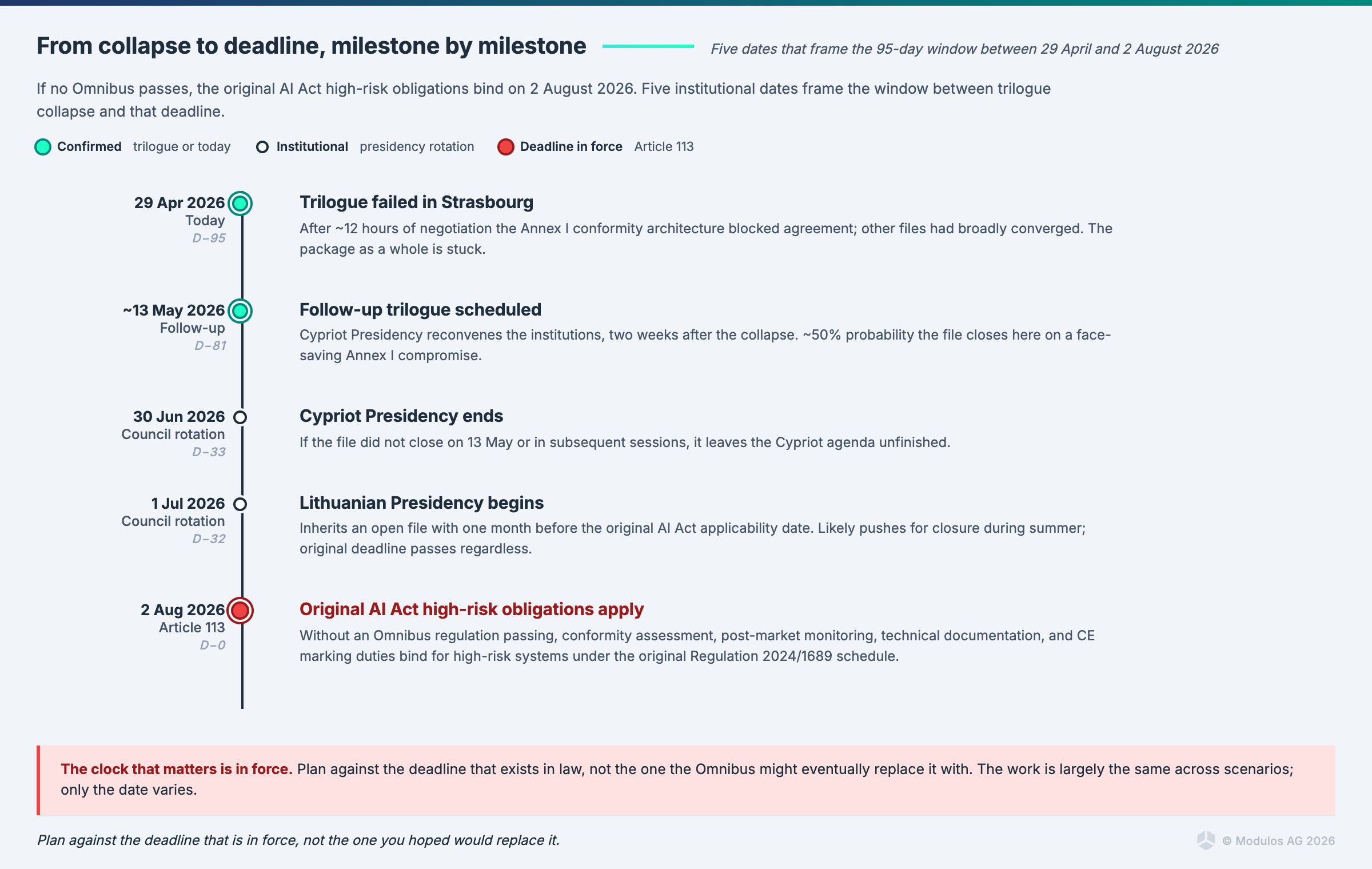
The trilogue on the EU AI Act Omnibus closed on 28 April 2026 without a political agreement after roughly 12 hours of negotiations. The package was meant to postpone the August 2026 high-risk deadline, narrow Annex III, and integrate AI obligations with sectoral product safety law, but none of those changes passed. The original AI Act deadlines remain legally in force, and a follow-up trilogue has been scheduled for approximately 13 May 2026.
If you run a compliance program and you've been planning against an assumed postponement, stop. The deadline you should be planning against is the one already in the law: 2 August 2026.
Key facts
- The 28 April 2026 trilogue ended without political agreement.
- The unresolved file was the architecture for AI in regulated products under Annex I, specifically the conformity-assessment relationship between the AI Act and existing sectoral safety law (Machinery Regulation, MDR, IVDR, etc.).
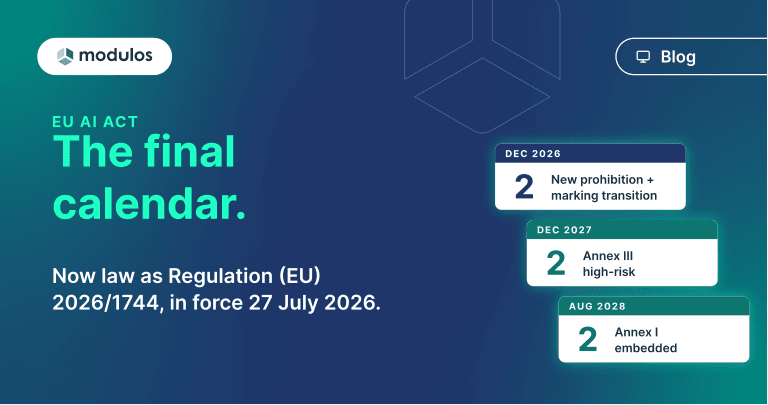
- Other elements had broadly converged before the collapse: postponed deadlines (2 December 2027 for stand-alone Annex III, 2 August 2028 for Annex I products), prohibition on non-consensual intimate imagery, simplified registration database, GPAI obligations under Articles 50–55 left intact.
- Without an Omnibus passing, the original 2 August 2026 high-risk applicability date legally stands.
- A follow-up trilogue is scheduled for approximately 13 May 2026, two weeks after the collapse, under the Cypriot Presidency. Rapporteurs Kokalari (EPP, Sweden) and McNamara (Renew, Ireland) brief at 11:00 CEST today in Strasbourg.
What actually happened
The Omnibus is the European Commission's simplification package, proposed in November 2025, that amended several digital files at once including the AI Act, GDPR, the Data Act, and the e-Privacy Directive. The political bargain on the AI portion was straightforward: industry and member states said the August 2026 high-risk deadline was unworkable without harmonised standards in place; the Commission proposed a postponement; Parliament and Council agreed on most of the substance. The trilogue on 28 April was meant to close the file before the OJ publication target of July 2026.
After roughly 12 hours of negotiations, the institutions did not converge on one file, and that single disagreement was sufficient to block the entire package. The unresolved file is Annex I, specifically the conformity assessment architecture for AI systems embedded in regulated products like industrial machinery, medical devices, and in-vitro diagnostics.
The other major elements had largely converged before the collapse: the postponed dates were agreed, the registration database in Article 49 survived in streamlined form, GPAI obligations were left intact, a new prohibition on AI-generated non-consensual intimate imagery was added to Article 5, and the bias-detection legal basis was broadened. Most of the substantive direction is therefore visible already, even if the legal vehicle is stuck.
Why one file blocked the whole package
Annex I has two sections in the current AI Act. Section A products (including those covered by the Machinery Regulation 2023/1230, the Medical Devices Regulation, and the In-Vitro Diagnostic Medical Devices Regulation) get a combined conformity assessment under both the AI Act and the relevant sectoral law, with the AI Office in the loop. Section B products are governed primarily through the sectoral track, with AI Act requirements integrated via delegated acts.
The European Parliament's negotiating position proposed moving Section A products to Section B, making sectoral conformity assessment the primary pathway and integrating AI Act requirements into existing product-safety frameworks. The Council resisted. The institutions did not converge on this single architectural question, and that disagreement was sufficient to block the entire package.
This is not a technicality. Where conformity assessment lives determines who designates the notified bodies, what rules apply to software updates, and how the AI Office's enforcement reach intersects with sectoral regulators. Both institutions had defensible positions and neither moved, so the file did not close.
Four scenarios for what happens next
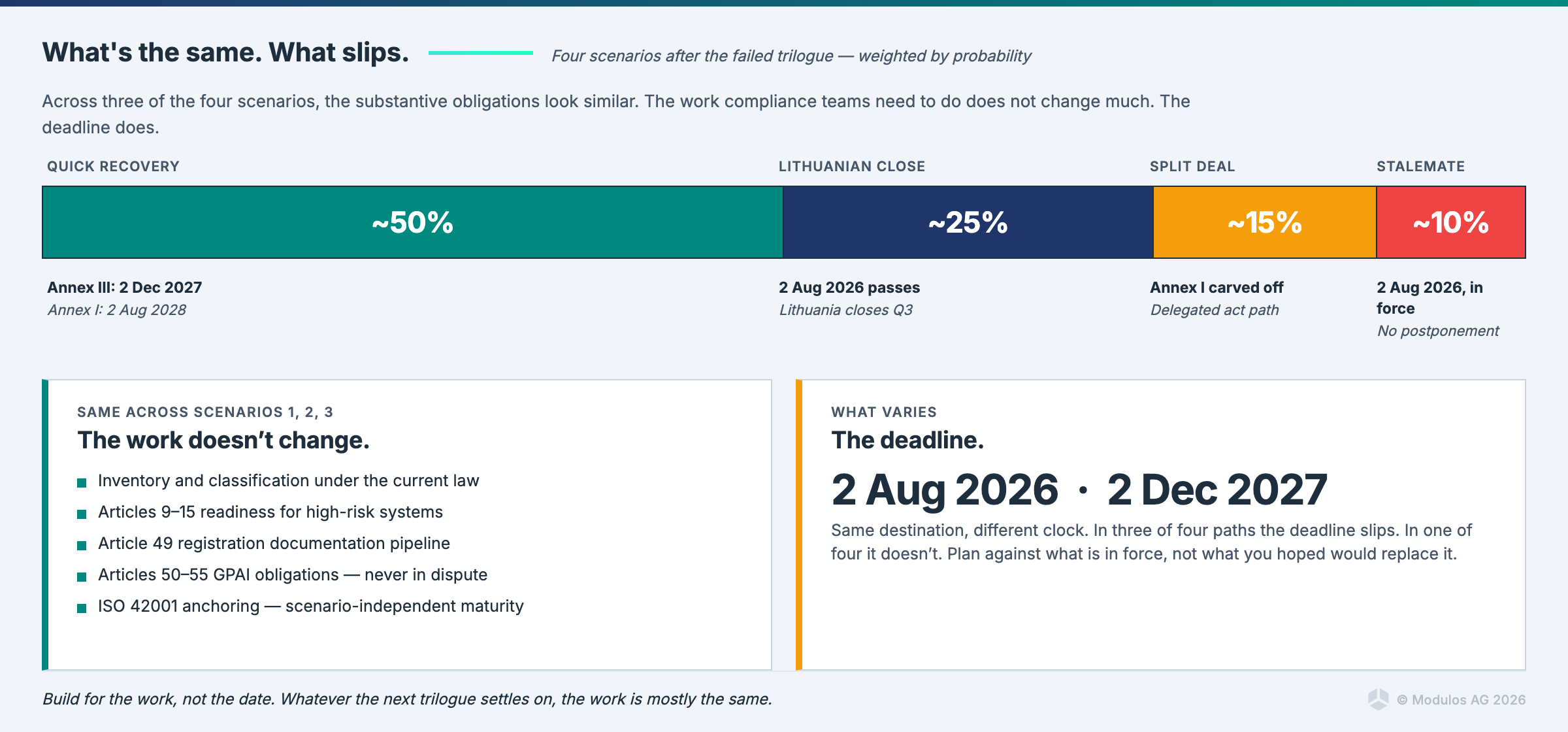
Anyone who tells you they know exactly what comes next is overconfident. Here are the four plausible paths, with rough probability weights based on what's publicly known.
Scenario 1: Quick recovery in May (~50%). A follow-up trilogue is scheduled for approximately 13 May 2026, two weeks after the collapse. A face-saving compromise on Annex I architecture is found, most likely a partial split where some product categories stay in Section A and others move to Section B, or a reference to delegated acts that defers the architecture question. Deal closes, OJ publication July 2026, deadlines apply as previously agreed (2 December 2027 for Annex III, 2 August 2028 for Annex I).
Scenario 2: Lithuanian Presidency closes in Q3 (~25%). The 13 May trilogue does not close the file. The Cypriot term ends 30 June 2026 without a deal, Lithuania takes over 1 July, and pushes through agreement during summer. The original 2 August 2026 deadline passes with no postponement legally in force, and the Commission likely issues forbearance or transitional guidance to manage the gap. Deal closes in Q3 and applies retrospectively or with adjusted timing.
Scenario 3: Split deal (~15%). Annex I gets carved off into a separate file. The rest of the Omnibus (agreed Annex III postponement, registration, GPAI, deepfake ban) passes on the previously-converged terms. Industrial AI is handled separately, possibly via a Commission delegated act under Article 96, possibly via a new legislative proposal. This unsticks most of the file but leaves industrial-AI uncertainty for longer.
Scenario 4: Stalemate (~10%). No deal before 2 August 2026. The original AI Act high-risk obligations apply with no postponement, no harmonised standards, and limited notified body capacity, which puts significant pressure on the Commission for transitional guidance. This is the worst outcome for legal certainty and the one most likely to undermine the AI Act's enforceability long-term if it persists.
The non-obvious point worth holding onto: in three of the four scenarios, the substantive obligations end up looking similar to what was already converged. What varies is the legal effective date and the enforcement environment between now and then. The work compliance teams need to do does not change much across scenarios. The clock does.
What to do this week, this month, this quarter
Concrete actions in three time horizons.
This week. Inventory your AI systems against the current law, not the expected-postponed version. If you classified anything as out-of-scope on the assumption that the Omnibus would narrow Annex III in employment or education, re-check that classification against the actual Annex III text in force today. Identify your single point of accountability for AI Act readiness, and name the person in writing.
This month. Run a gap assessment against AI Act Articles 9 through 15 for any system that is high-risk under the current law: risk management, data governance, technical documentation, record-keeping, transparency, human oversight, accuracy, robustness, cybersecurity. For GPAI providers, confirm Articles 50–55 readiness, since those obligations were never in dispute and remain on schedule. For Annex I products specifically, engage your notified body now, because capacity is already constrained and the post-collapse environment makes it worse.
This quarter. Build the registration documentation pipeline. The Article 49 registration database survives in all four scenarios, and building toward it is robust to any outcome. Begin synthetic-content disclosure engineering (UI labels, metadata embedding, detection at the edge), which will be required regardless of when Article 50 obligations bite. Anchor your AI governance framework against ISO 42001. Scenario-independent maturity is the asset, and whatever clock the trilogue eventually settles on, that maturity holds.
The operational summary: do the work that's robust to all four scenarios, and stop optimizing for the one outcome you hoped would happen.
Frequently asked questions
What is the EU AI Act Omnibus? The Digital Omnibus is the European Commission's simplification package, proposed on 19 November 2025, that amends the AI Act and several adjacent digital files (GDPR, Data Act, e-Privacy Directive). The AI portion postpones the high-risk applicability deadline, narrows parts of Annex III, simplifies registration and conformity obligations, and adds new provisions including a prohibition on non-consensual AI-generated intimate imagery.
Did the AI Act Omnibus pass? No. The political trilogue on 28 April 2026 ended without an agreement. A follow-up trilogue is expected within weeks under the Cypriot Presidency or its successor.
Why did the AI Omnibus trilogue fail? The Council and Parliament did not converge on the conformity-assessment architecture for AI in regulated products under Annex I, specifically whether Section A products such as machinery and medical devices should remain in combined AI Act and sectoral assessment or move to Section B for primarily sectoral handling. Other files had broadly converged before the collapse.
Is the August 2, 2026 EU AI Act deadline still in force? Yes. Without an Omnibus regulation passing, the original applicability dates in the AI Act (Regulation 2024/1689, Article 113) remain legally in force, including the 2 August 2026 date for high-risk system obligations.
What is high-risk AI under the EU AI Act? The AI Act treats two routes to high-risk classification. Route one (Annex I): AI as a safety component in a product covered by listed sectoral safety law where third-party conformity assessment is required. Route two (Annex III): stand-alone AI in defined high-risk use cases including biometrics, critical infrastructure, education, employment, essential services, law enforcement, justice, and migration.
What is the difference between Annex I and Annex III of the AI Act? Annex I covers AI embedded as a safety component in products already regulated under EU sectoral safety law (machinery, medical devices, toys, lifts, vehicles, aviation, etc.). Annex III covers stand-alone AI systems used in specific high-risk contexts unrelated to product safety. Different conformity pathways, different governing instruments, different deadlines.
When will the next AI Omnibus trilogue happen? A follow-up political trilogue is scheduled for approximately 13 May 2026, two weeks after the failed 28 April session. The Cypriot Council Presidency will attempt to close the file before its term ends on 30 June 2026; otherwise the Lithuanian Presidency takes over from 1 July 2026 and may continue negotiations.
Does the AI Omnibus failure affect GPAI providers? Largely no. General-purpose AI obligations under Articles 50–55 of the AI Act were not in substantive dispute during the trilogue and remain on their current schedule. The Code of Practice on synthetic content is expected to finalise in May or June 2026.
What should businesses do if the AI Omnibus does not pass before 2 August 2026? Plan against the original deadline. Inventory and classify systems under the current law. Build registration and technical documentation pipelines. Engage notified bodies now. Anchor governance to ISO 42001. The work is robust to all scenarios; only the deadline varies.
What are the penalties for non-compliance with the EU AI Act? Up to 7% of global annual turnover or €35 million (whichever is higher) for prohibited AI practices under Article 5; up to 3% or €15 million for breaches of high-risk obligations and other operator duties; up to 1% or €7.5 million for supplying incorrect, incomplete, or misleading information to authorities. Penalties are tiered and apply per Article 99.
Modulos's commitment
Across all four scenarios, the work compliance teams need to do is largely the same. Inventory, classify, document, govern, register, prepare conformity. What varies is the deadline, not the destination.
Modulos's position is straightforward: regardless of when or how the trilogue eventually closes, we help organisations build AI governance programs that are robust to the outcome. If the deal closes in May with the previously-converged dates, we help you execute against December 2027. If the deadline holds at 2 August 2026, we help you triage what must be done now versus what can be sequenced. If the deal splits, we help you operate across two clocks at once.
The companies that did the homework before this trilogue are not the losers in this story. They are the ones who execute through uncertainty and emerge with operational maturity intact. That is the bet, and we make it with our customers every day.
If you want a 30-minute session to map your current AI inventory against Annex III and Annex I criteria as they stand today, book a call with our team. The next trilogue will resolve whatever it resolves. Your portfolio readiness shouldn't depend on it.
Ready to Transform Your AI Governance?
Discover how Modulos can help your organization build compliant and trustworthy AI systems.