Ask Your AI Governance Tool These 7 Questions
If It Can't Answer, It's a Chatbot
AI governance tools: 7 buyer queries for 2026
Modulos · May 2026 · 12 min read
AI governance tools are now a procurement requirement for any enterprise that builds, buys, or deploys AI systems. With the EU AI Act's high-risk deadline arriving on 2 August 2026 and ISO/IEC 42001 certification becoming a market differentiator, the question is no longer whether to invest in governance. It is which platform actually does the work.
Most AI governance tools on the market are dashboards with a chat window bolted on. They look impressive in a demo, but they fall apart the moment you ask them to do real work: classify a live system under the EU AI Act, run a security review against an actual codebase, or tell the board how much financial exposure a specific AI system carries.
The difference between a genuine AI governance platform and a dressed-up chatbot becomes obvious the moment you test it with queries that require operational depth: reasoning across your data, connecting to your infrastructure, and producing outputs that would survive an audit.
We built Scout, the AI agent inside the Modulos platform, to close exactly that gap. Here are seven real queries you can run against any AI governance tool you are evaluating. They will tell you, in minutes, whether you are looking at a platform or a brochure.
What is an AI governance tool?
An AI governance tool is software that helps organisations manage the risk, compliance, and oversight of AI systems across their lifecycle. The category covers everything from spreadsheet-based trackers to purpose-built AI GRC platforms, and the term has been stretched to include nearly any product with a chat interface and a compliance label.
A genuine AI governance platform connects to your AI assets, applies regulatory frameworks like the EU AI Act and ISO/IEC 42001, automates evidence collection, and produces audit-ready outputs. A chatbot wrapper does none of these things, even when its marketing pages suggest otherwise. For a deeper foundation on the discipline itself, our guide to AI governance covers the building blocks every platform should support.
Why the right test for AI governance tools is a query, not a feature list
Feature checklists are how most enterprises evaluate AI governance tools today. Vendors are asked whether they support the EU AI Act, whether they handle risk assessment, and whether they ship an AI assistant. Every vendor ticks the same boxes.
The real differentiation lies in what happens when you actually use the tool on your data, against your systems, with your regulatory obligations. A vendor's slide can describe many features, but only a working query produces a result you can act on.
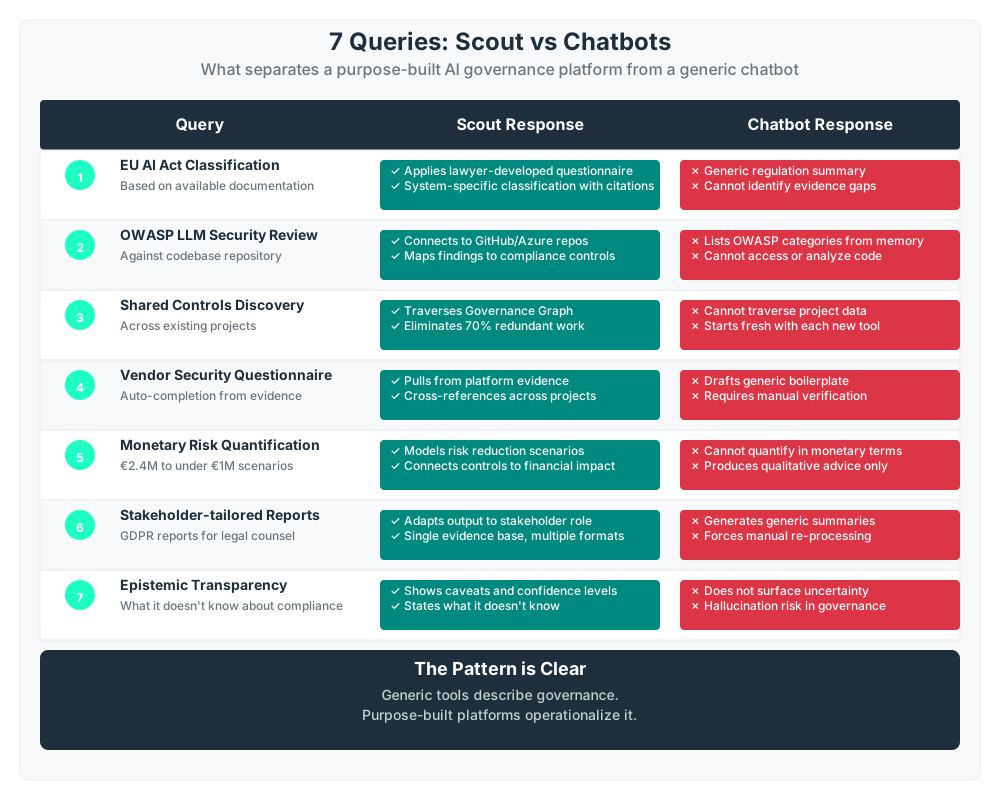
These seven queries are designed to expose that gap. Each one represents a real governance task that enterprises face weekly. For each, we show what Scout does, and what a generic chatbot-style tool typically cannot.
Query 1: Classify this system under the EU AI Act based on the available documentation
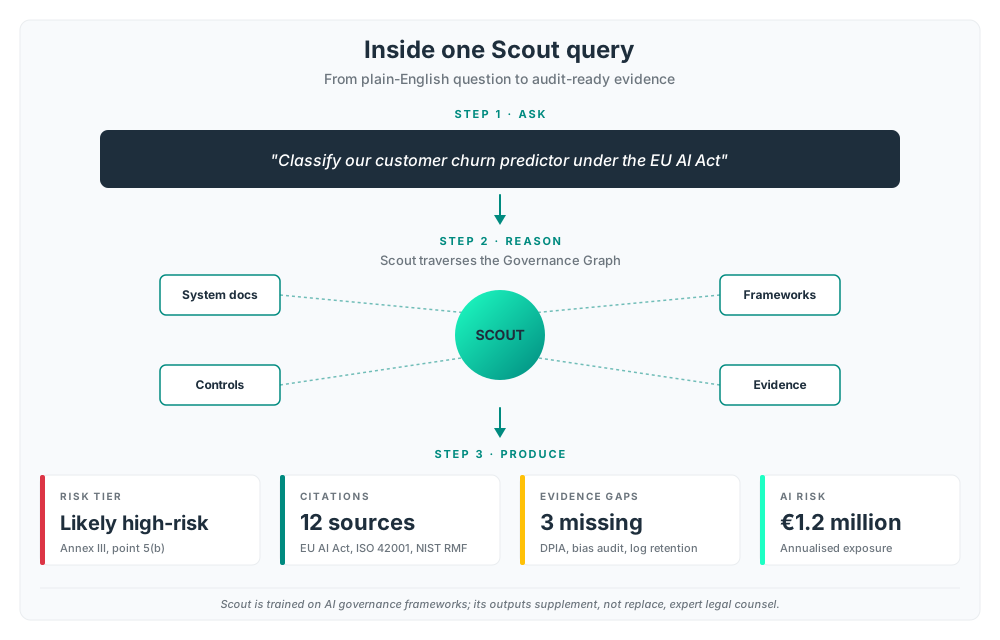
What Scout does: Scout applies Modulos' lawyer-developed questionnaire to the EU AI Act risk taxonomy, walks through its reasoning with citations, and classifies the system as minimal, limited, high-risk, or prohibited. It also flags uncertainty and tells you which documents would sharpen the result. The reasoning is grounded in the EU AI Act framework documentation inside the platform.
What a chatbot does: A chatbot summarises Article 6 criteria from its training data, but it cannot apply them to a specific system or identify evidence gaps in your documentation. The answer it gives is generic, the kind of thing you could have found on the European Commission's website.
Why it matters: The EU AI Act's high-risk system deadline is 2 August 2026. Classification is the first step in conformity assessment, and getting it wrong means either over-investing in compliance for a minimal-risk system or under-governing a system that could trigger penalties of up to €35 million.
Query 2: Run a security review of this application against the OWASP Top 10 for LLM Applications
What Scout does: Scout connects to your GitHub, Bitbucket, or Azure repository and executes a structured review across all 10 OWASP LLM categories, including prompt injection, data leakage, insecure output handling, and seven more. The output is a report mapped to controls that converts directly into compliance evidence inside the platform.
What a chatbot does: A chatbot can list the OWASP LLM Top 10 categories from memory, but it cannot connect to a codebase or analyse a specific system. What you get back is a reading list rather than a security review.
Why it matters: LLM security is the fastest-growing risk surface in enterprise AI. A governance tool that cannot inspect code against policy is functionally a reporting layer, with no way to enforce the policies it documents.
Query 3: What controls and evidence do we already have that apply to this new AI tool?
What Scout does: Scout traverses the Governance Graph across all existing projects, identifies which controls are already satisfied, and shows gaps framework by framework. By surfacing shared controls that satisfy the EU AI Act, ISO/IEC 42001, the NIST AI Risk Management Framework (NIST AI RMF), and OWASP simultaneously, Scout eliminates up to 70% of redundant work. Our global AI compliance guide walks through how shared controls compound across jurisdictions.
What a chatbot does: A chatbot can search a knowledge base for related controls, but it cannot traverse project data or tell you what has already been done. Every new tool starts from zero.
Why it matters: This is where governance programmes either scale or collapse. If every new AI system requires fresh compliance work across each framework independently, cost and time grow linearly. Shared controls make governance sublinear, so that the more systems you govern, the less marginal work each new one requires. See how Xayn achieved ISO 42001 certification using this approach.
Query 4: Complete this vendor security questionnaire
What Scout does: Scout takes a 60-page Excel or PowerPoint vendor security questionnaire and pulls answers from data already in the platform, cross-referencing controls and evidence across projects. The questionnaire is auto-filled in minutes, with insufficient-evidence questions flagged for review. Scout also highlights where an answer was discovered organically from existing governance data rather than entered manually.
What a chatbot does: A chatbot drafts generic answers based on training data, with no ability to pull from your actual governance data or cross-reference evidence across projects. The output is boilerplate that still needs a human to verify every line.
Why it matters: Vendor security questionnaires are one of the most time-consuming tasks in enterprise governance. A 60-page questionnaire that takes a team two weeks to complete manually takes Scout minutes, and at higher accuracy, because answers are sourced from actual evidence rather than institutional memory.
Query 5: How can we reduce the risk exposure of this system from €2.4M to under €1M?
What Scout does: Scout models risk reduction scenarios with specific mitigations, connecting controls to financial impact via Monte Carlo simulation. The board sees a path from current exposure to target exposure with concrete actions, which turns governance from a cost-centre conversation into an investment one.
What a chatbot does: A chatbot cannot quantify AI risk in monetary terms or model scenarios against your specific system's risk profile. The advice it produces is qualitative, such as "consider implementing stronger access controls", with no connection to financial outcomes.
Why it matters: Board-level AI governance requires numbers. When risk is expressed as €2.4M of exposure that can be reduced to €900K through three specific control implementations, the conversation shifts from "do we need governance?" to "which mitigations give us the best return?" That shift is what separates governance treated as overhead from governance treated as strategy.
Query 6: Generate a GDPR compliance report for this AI system, tailored for legal counsel
What Scout does: Scout adapts each output to the stakeholder role. Legal teams receive consent analysis and DPIAs, the CISO receives risk posture, and the board receives financial exposure. All of these come from the same underlying evidence, with no re-work per audience.
What a chatbot does: A chatbot generates a generic GDPR summary that cannot be tailored to stakeholder roles or grounded in project-specific evidence. Legal will end up rewriting the result from scratch.
Why it matters: Governance is consumed by different audiences, including legal, security, the board, and regulators. A tool that produces one generic output forces every team to re-process it for their context. Scout produces role-appropriate outputs from a single evidence base, which eliminates the telephone game between governance and its consumers.
Query 7: What don't you know about this system's compliance status?
What Scout does: Scout shows caveats, confidence levels, and evidence gaps, and tells you which additional documents would improve confidence. The full reasoning chain is visible with citations, drawn from the ISO 42001 documentation and other framework sources, and every recommendation requires human approval.
What a chatbot does: A chatbot does not surface what it doesn't know, and instead fills gaps with plausible-sounding text. Because it cannot distinguish between high-confidence and low-confidence answers, hallucination risk in governance becomes dangerous.
Why it matters: This is the query that separates a trustworthy AI governance tool from a liability. The ability to say "I don't know this, and here's what would help" is more valuable in governance than a confident answer that might be wrong. Scout is built to state what it does not know, which is just as important as what it does know.
What these queries reveal about AI governance tools
Run these seven queries against any tool you are evaluating. The results will sort your shortlist faster than any feature matrix.
| Capability | Purpose-built AI governance platform (Modulos) | Generic GRC with AI add-on | Chatbot / copilot layer |
|---|---|---|---|
| EU AI Act classification against your evidence | Yes: lawyer-developed, system-specific | Partial: generic questionnaire | No: summarises regulation only |
| Codebase security review (OWASP LLM Top 10) | Yes: connects to repos, maps to controls | No | No |
| Cross-project shared control identification | Yes: Governance Graph traversal | No: siloed per project | No |
| Vendor questionnaire auto-completion from evidence | Yes: pulls from platform data | Partial: manual input required | Generic drafting only |
| Monetary risk quantification and scenario modelling | Yes: per threat vector | No: qualitative matrices | No |
| Stakeholder-tailored compliance reports | Yes: role-adapted outputs | Single format | Generic output |
| Epistemic transparency (what it doesn't know) | Yes: confidence levels, evidence gaps, citations | Limited | No: hallucination risk |
The pattern across these queries is consistent. Generic tools describe governance, while purpose-built platforms operationalise it.
How AI governance tools compare on platform capability
Beyond the seven queries, the buyer's view of AI governance tools comes down to a small set of platform capabilities that determine whether a tool can carry a compliance programme through the August 2026 deadline.
| Criterion | Purpose-built AI GRC (Modulos) | Generic GRC tool | Manual / spreadsheet |
|---|---|---|---|
| Multi-framework support | Yes: EU AI Act, ISO 42001, NIST AI RMF, OWASP in one platform | Partial: requires configuration | No |
| Quantitative risk scoring | Yes: monetary values via Monte Carlo | No: qualitative only | No |
| Evidence automation | Yes: AI agents collect from GitHub, Confluence, cloud infra | No | No |
| EU AI Act scoping | Built-in questionnaire | Manual | Manual |
| Deployment options | SaaS, private cloud, on-premise | Usually SaaS only | N/A |
| ISO 42001 certification | Supported: Modulos is certified | Not supported | Not supported |
The infrastructure behind Scout
Scout's capabilities go beyond prompt engineering over a language model. They depend on the Governance Graph, a connected data model that links every AI asset, control, risk, framework requirement, and piece of evidence in the platform. When Scout answers a query, it reasons across this graph, tracing from a specific AI system through its applicable frameworks, existing controls, evidence gaps, and quantified risk exposure.
This is why Scout can do things a chatbot cannot. Where a chatbot only has access to its training data, Scout reaches into your governance data, with the graph structure to reason across it.
Modulos is the first platform globally to be compliant against ISO/IEC 42001, independently evaluated by CertX. The platform meets the same standards it helps customers achieve.
Ready to test these queries on your own systems?
Pick any one of the seven queries above and run it against your current tooling. If the answer comes back generic, with no ability to reference your specific systems, your evidence, or your financial exposure, you know the gap.
Ready to see how Modulos handles these queries? Request a demo and we will walk you through how the platform operationalises AI governance for your organisation, ahead of the August 2026 EU AI Act deadline.
© 2026 Modulos AG. All rights reserved.