AI Governance ROI: How to Prove Value to the Board
The steps a governance team can take, and the figure each one gives it to report
Boards and executive teams are pushing AI adoption, and the wider business often sees the governance team as the group that will say no. Two numbers show what is at stake. In EY's 2025 survey of 975 executives at large companies, 99% reported financial losses from AI risks, which EY conservatively estimates at $4.4 million on average per affected company. On the value side, MIT NANDA's 2025 study The GenAI Divide, which reviewed more than 300 public AI initiatives, found that only about 5% of integrated generative AI pilots were producing millions in value.
A governance team that knows which AI systems the company runs, what each one is worth and what each one could cost can improve adoption and show the numbers that prove it. This post sets out five steps that get a team there. Each step produces a figure that one audience in the company wants to see, and the table below is the short version.
| Audience | What governance offers them | Figure to report |
|---|---|---|
| Board and executive team | A full view of AI use across the company, with AI risk reported next to other business risks | Number of AI systems in use, and total AI risk in euros |
| CFO | Lower spend through consolidation, and investment decisions that compare expected return with expected loss | Cost saved by consolidation, and return per euro of risk for each candidate |
| Business unit leaders | Approved tools that match what their teams were building for themselves | Number of duplicate agents replaced by approved ones |
| Employees | Training on safe use, and better tools in place of personal workarounds | Share of staff who have completed AI literacy training |
| Sales and procurement | Faster answers to customer and supplier compliance questions | Time taken to answer a compliance questionnaire |
Watch the video: How AI governance teams add measurable value shows these steps in six minutes, and the page has a one-page summary to download.
Why is the AI governance team seen as the group that says no?
The pressure comes from two sides. Senior management expects the governance team to keep the company safe and compliant. Colleagues who have been told to adopt AI expect the team to stay out of their way, and some governance leaders soften their oversight to avoid being seen as the blocker. That choice leaves the company with less oversight and no more value.
The value is hard to see in most companies. In the McKinsey survey published in March 2025, more than 80 percent of respondents said their organizations were not yet seeing a tangible effect on enterprise-level EBIT from generative AI. The same survey found CEO oversight of AI governance among the factors most correlated with self-reported bottom-line impact from generative AI, yet only 28 percent of respondents at companies that use AI said their CEO holds that role.
The way out of the blocker role is to bring a number that nobody else in the company has: what each AI system could cost. The steps below produce it, and they start with knowing what exists.
How do you find the AI already in use in your organization?
A governance team can avoid blocking AI and still insist on knowing what is running. Discovery means scanning the environments where people build and use AI, such as Microsoft Copilot, Databricks, Azure and AWS, and listing every application and agent found there.
The need is real. IBM's 2025 Cost of a Data Breach report studied 600 organizations that had a breach. One in five of them had a breach caused by shadow AI, and breaches at organizations with high levels of shadow AI cost an average of $670,000 more than at those with little or none. Only 37% had policies to manage AI or detect shadow AI.
People build their own tools for three main reasons, and each reason points to a different fix.
| Why the tool was built | The fix |
|---|---|
| The builder did not know that a certain type of data should not go into a certain tool | Training |
| Someone needed a tool, such as a note-taking assistant, and the company did not offer one | A new approved tool |
| The company offers a tool, but it was chosen mainly on price and lacks the features people want | A better tool |
A system that fits none of the three deserves a closer look, because its purpose may be one the company would not accept. For everything else, read the discovery list as demand research. It shows what people need from AI badly enough to build it themselves, which is the best input a tooling budget can get. We have written before about how shadow AI spreads and how to find it.
The figure to report after this step is the number of AI systems in use, each with an owner.
How do you consolidate duplicate AI tools and agents?
In our experience, a first discovery exercise nearly always shows heavy duplication. Many people will have built a note-taking tool, and sales, marketing and HR staff will each have built their own agents. A company can end up with 100 sales agents that do broadly the same job, each built by a different person with limited knowledge of how to build one well.
The governance team reviews those agents, identifies the features that matter, and specifies one well-built agent for everyone. Nobody is told to stop. The team has learned what people were trying to achieve and has given them a better way to do it, which is the opposite of the role the business expected the team to play.
The savings can be counted in four places:
- Token costs. One agent replaces many overlapping ones.
- Staff time. People stop building and maintaining personal tools.
- Energy and compute. Fewer systems run in parallel.
- Oversight. A smaller inventory costs less to govern.
Business unit leaders care about the count of duplicate agents replaced by approved ones, and the CFO cares about the spend that went with them. Record both before the consolidation starts, because the comparison is hard to rebuild afterwards. Agents built in low-code tools are the usual starting point, and our page on Copilot Studio governance covers that case.
How do you choose AI investments by expected return and expected loss?
Each consolidated agent needs a decision: build it, buy it, or buy it and adapt it. Most companies make that decision on expected return alone, which uses half of the available information. The missing half is the expected loss across technical, legal, compliance, reputational and operational risk, and the EY figure above shows that this loss is material.
Take five candidate systems. Ranked on expected return, System A is funded first because it promises the largest return. Add the expected loss, and the order changes.
| System | Expected return | Expected loss | Return per euro of risk |
|---|---|---|---|
| A | €1.0M | €1.1M | €0.91 |
| C | €900K | €700K | €1.29 |
| B | €750K | €100K | €7.50 |
| D | €500K | €125K | €4.00 |
| E | €300K | €400K | €0.75 |
System B returns €7.50 for each euro of risk. System A returns €0.91, so its expected loss is larger than its expected return, and it was first in the queue. The figures are illustrative. They show what a ranking by return hides: System A has the highest expected return and also the highest expected loss.
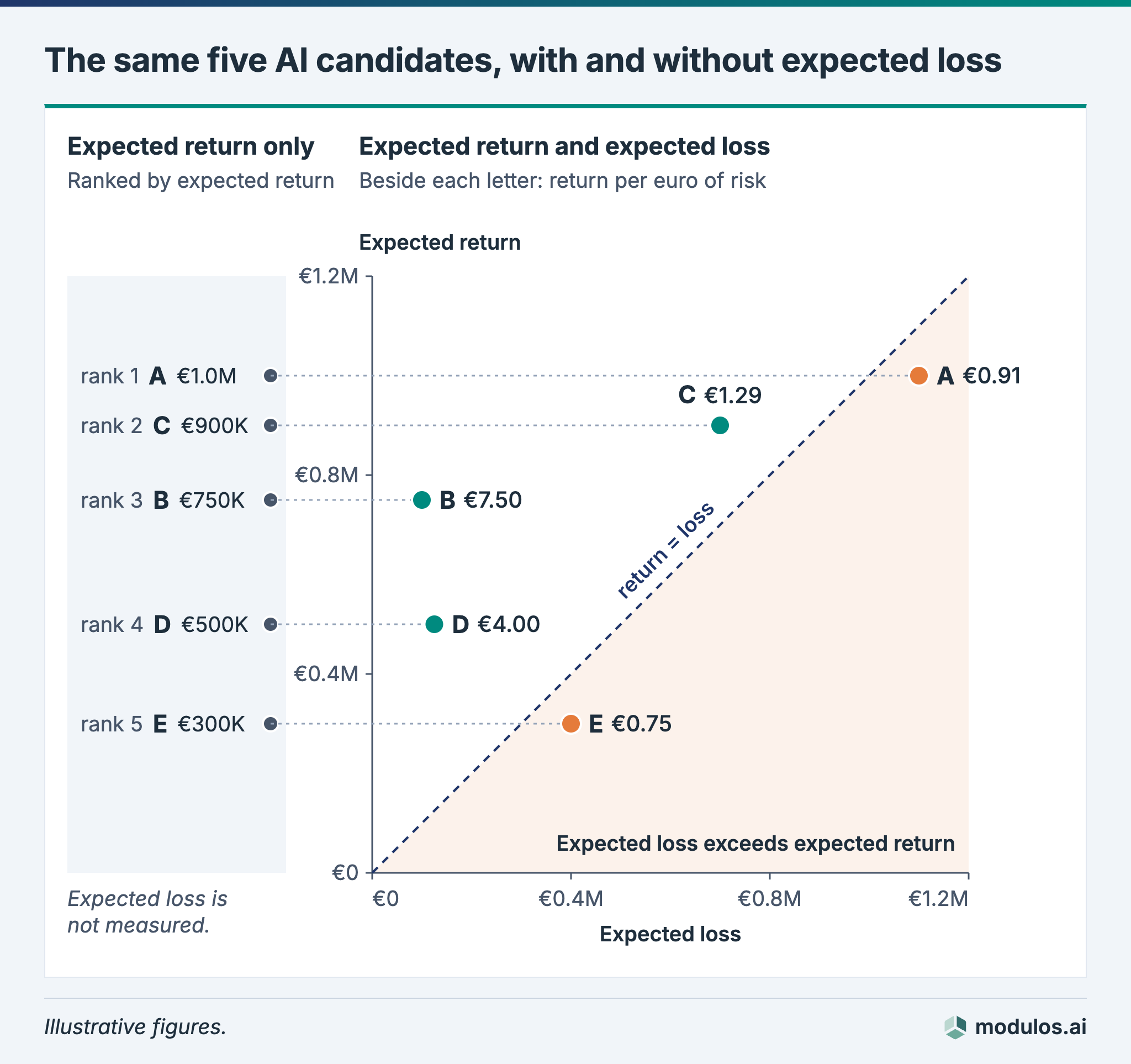
The governance team supplies the expected loss figure, and the CFO and the business gain a like-for-like comparison they did not have before. The same comparison works for internal build priorities and for build-versus-buy choices. An expected loss is an estimate, so treat a ratio near 1 as "not proven to pay" and ask for a second look before the money moves. We describe the method in the AI value-to-risk ratio and in The ROI of AI: the risk you're not pricing.
How do you quantify AI risk in money and fix the policies behind it?
Approval is where the work on a system starts. Much of the risk in an approved inventory comes from the controls and policies behind it. A common example is a generic data policy written five years ago, which says too little to govern what AI systems do today.
The breach data points the same way. IBM found that 63% of breached organizations had no AI governance policy or were still developing one. Of the 13% of organizations that reported a breach of an AI model or application, 97% said they had no AI access controls. The count of incidents is rising as well: the AI Incident Database logged 362 incidents in 2025, up from 233 in 2024, according to Stanford's 2026 AI Index.
Quantify the risk of each approved system in money, and then look at where the total concentrates: by owner, by system, by geography or by control. Suppose the result shows that 50% of total risk traces back to one data policy used by 250 systems. The team rewrites that one policy, the clearer guidance carries through to all 250 systems, and the team reports the reduction in euros. One edit with a measured effect across 250 systems is a result a board understands at once, and it costs far less than 250 separate reviews.
The figure to report is the total AI risk in euros, and how much each fix took off it. The background on putting a monetary value on AI risk is in our paper on Fermi estimates for AI risk.
How do you answer AI compliance questions faster?
Governance teams field a steady flow of compliance questions from customers, auditors and internal stakeholders. Most of the answers already exist in the governance records: which systems are in use, which controls apply to them and what evidence supports each control. A team that drafts its answers from those records, with an AI agent doing the first draft, stops writing the same answer many times.
Sales and procurement get answers sooner, and the governance team spends less time on repetitive requests. The figure to track is the time taken to answer a compliance questionnaire, measured before and after. Our guide When half a team disappears into questionnaires covers the cost of the manual route.
What should you ask your executive team about AI?
Three questions show quickly whether the company has the numbers.
- How many AI systems do we run? Include vendor-embedded and employee-adopted AI, with an owner for each. If the answer takes a week, the inventory does not exist.
- What is our expected loss from AI? Put it in currency, next to the value claimed in approved business cases. Where there is no figure, every approval carries risk that nobody has priced.
- How fast could we produce evidence? Time how long it takes to document one high-risk system for a regulator or a customer. Weeks is typical, and hours is the target.
Does AI governance pay off?
The surveys associate governance practices with better reported outcomes, with the usual caution that these are correlations. EY found that executives with real-time AI monitoring were 34% more likely to report better revenue growth and 65% more likely to report better cost savings. Gartner's 2025 survey of 360 organizations found that those which regularly assess their AI systems were more than three times as likely to report high generative AI value, and that those investing in third-party AI governance products were 1.9 times as likely to report it. Gartner also reports that organizations with an AI governance platform were 3.4 times more likely to rate their AI governance as highly effective, and it projects that effective governance technology could cut regulatory costs by 20% as fragmented AI regulation quadruples by 2030.
One survey stands behind three of those figures, so take them as direction. The stronger argument is the one your own company can check: without a risk number, a company approves AI on high expected returns while unaware of the expected losses attached. A governance team that supplies the number helps the company choose better AI investments, and the function moves from cost center to source of value.
Where does Modulos fit?
Modulos is an AI governance platform built for these steps. It scans the environments where people build AI and lists what it finds for review. Its Value and Risk view places every AI system by its annual value and its risk in money, with a break-even line. It calculates risk in monetary terms across every system, continuously, and shows it as a heat map by owner, system, geography or control. A user can paste a compliance question in, and an agent drafts the answer from the information already held in the platform.
For the wider program, read The CISO's Guide to AI Governance, or request a demo and bring one AI system and the business case that came with it.
Sources: EY Global Responsible AI Pulse survey (October 2025); MIT NANDA, The GenAI Divide: State of AI in Business 2025; IBM Cost of a Data Breach Report 2025; McKinsey, The state of AI (March 2025); Stanford HAI, AI Index Report 2026; Gartner press releases of 4 November 2025 and 17 February 2026. The systems, returns and losses in the investment example and the policy example are illustrative. Gartner does not endorse any vendor, product or service depicted in its research publications.
Ready to Transform Your AI Governance?
Discover how Modulos can help your organization build compliant and trustworthy AI systems.