For compliance, risk, and product leaders
AI Governance
by Industry
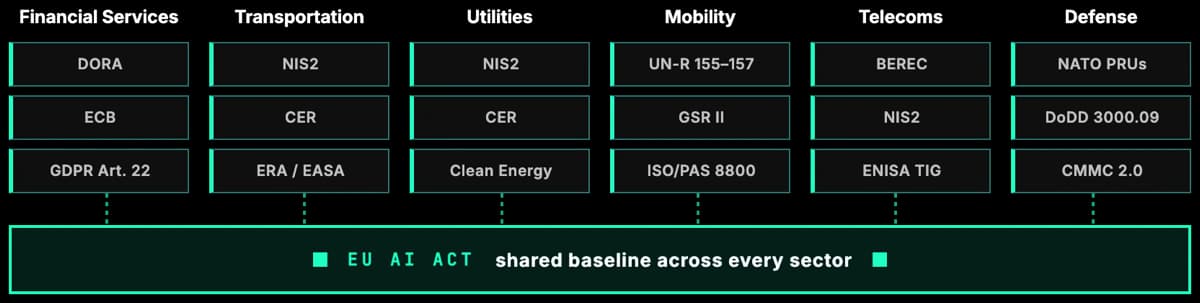
The EU AI Act is the primary driver of AI governance work in every regulated sector. How it lands depends on the industry: which Annex III category applies, which sector regulation layers on top, and which ISO or NIST control set gives you audit-grade evidence. Each industry page below explains exactly that.
Pick your industry
Six industries where AI governance is already a board-level topic. Pick your sector to see the applicable EU AI Act article, the sector rules that stack on top, and the AI use cases driving regulator attention.
Financial Services
Annex III Part 5 makes credit scoring and insurance pricing high risk under the EU AI Act. DORA, ECB model risk guidance, and ISO/IEC 42001 layer underneath.
Transportation
Annex III Part 2 classifies AI as a safety component for road, rail, air, and maritime traffic. NIS2 and the CER Directive sit behind for resilience.
Utilities
Grid AI for electricity, gas, water, and heating is Annex III high risk. NIS2 adds essential-entity cyber duties and CER Directive adds physical resilience.
Mobility
Article 6 ties the EU AI Act to UN-R 155, 156, 157 and the General Safety Regulation. ADAS, autonomous driving, and driver monitoring are high risk by design.
Telecommunications
Annex III Part 2 reaches network AI as a safety component of critical digital infrastructure. BEREC, ENISA, and NIS2 add sector-specific obligations.
Defense & National Security
Article 2(3) carves out exclusively military AI, but Recital 24 pulls dual-use and civilian lines back in. NATO PRUs and ISO/IEC 42001 cover the rest.
Which rules govern AI in your industry?
The same horizontal law, six different regime mixes. Rows link to the sector pages; the regulation columns link to deeper primers.
| Industry | EU AI Act | NIS2 | DORA | GDPR | ISO/IEC 42001 | Sector regimes |
|---|---|---|---|---|---|---|
| Financial Services | ●Annex III 5(b), 5(c) | DORA lex specialis | ● | ●Art. 22 | ● | —ECB model risk guide |
| Transportation | ●Annex III Part 2 | ●essential entity | — | ○ | ● | —CER · ERA, EASA, EMSA |
| Utilities | ●Annex III Part 2 | ●essential entity | — | ○smart metering | ● | —CER · ACER |
| Mobility | ●Art. 6(1) product track | — | — | ○cabin biometrics | ● | —UN-R 155/156/157 · GSR |
| Telecommunications | ●Annex III Part 2 | ●essential entity | — | ●plus ePrivacy | ● | —BEREC · ENISA |
| Defense & National Security | Art. 2(3) carve-out, dual-use in scope | — | — | — | ● | —NATO · DoDD 3000.09 · CMMC 2.0 |
● primary driver · ○ applies · — not a focus for this sector. Orientation, not legal advice.
Why the same governance programme works in every sector
The EU AI Act sets the horizontal baseline, but every regulated sector adds its own layer. A bank running an AI underwriting model reconciles the AI Act high-risk regime with DORA, ECB model risk expectations, and GDPR. A rail operator runs the same AI Act obligations against NIS2, the CER Directive, and safety rules from the European Union Agency for Railways. A mobility OEM runs UN Regulation 155, 156, and 157 alongside the AI Act and ISO/PAS 8800.
The cost of treating AI governance as a single cross-cutting programme is duplicate work. Each team ends up maintaining its own spreadsheet of controls, its own incident playbook, its own evidence store. Modulos is built on a single governance graph, so a control written once for ISO/IEC 42001 also serves the EU AI Act, DORA, NIS2, and sector guidance. Everything traces back to the original requirement.
The industry pages below describe the specific regulatory pressure, the AI use cases most likely to be classified high-risk, and the governance pattern that actually works in that sector. They are starting points for AI governance strategy, board briefings, and vendor conversations, not a substitute for legal advice.
Map AI Governance to Your Industry
See how Modulos models sector-specific obligations, controls, and evidence in a single governance graph, so the EU AI Act, DORA, NIS2, and ISO/IEC 42001 stop competing for attention.