
Comply with the EU AI Act Without the Hassle
The EU AI Act sets the new global standard for AI regulation. We explain what it means for your organization and how Modulos helps you achieve compliance.
Fill out the form (only 30 seconds)
We respond within 24 hours
Quick call to understand your needs
Demo focused on your compliance priorities
Request a Demo
Trusted by over 200 organizations







Timeline and Compliance Milestones
Key dates for EU AI Act compliance.
The regulation officially enters into force
Prohibitions for unacceptable risks take effect along with AI literacy requirements
Obligations for GPAI providers and rules on authority notifications and fines take effect
Commission implementing act on post-market surveillance
Obligations for high-risk AI systems in biometrics, critical infrastructure and law enforcement (Annex III)
Obligations for high-risk AI systems as safety components or products requiring third-party conformity assessment (Annex I)
Conformity for AI systems in large-scale IT systems under EU law in the area of freedom, security and justice
The regulation officially enters into force
Prohibitions for unacceptable risks take effect along with AI literacy requirements
Obligations for GPAI providers and rules on authority notifications and fines take effect
Commission implementing act on post-market surveillance
Obligations for high-risk AI systems in biometrics, critical infrastructure and law enforcement (Annex III)
Obligations for high-risk AI systems as safety components or products requiring third-party conformity assessment (Annex I)
Conformity for AI systems in large-scale IT systems under EU law in the area of freedom, security and justice
The regulation officially enters into force
Prohibitions for unacceptable risks take effect along with AI literacy requirements
Obligations for GPAI providers and rules on authority notifications and fines take effect
Commission implementing act on post-market surveillance
Obligations for high-risk AI systems in biometrics, critical infrastructure and law enforcement (Annex III)
Obligations for high-risk AI systems as safety components or products requiring third-party conformity assessment (Annex I)
Conformity for AI systems in large-scale IT systems under EU law in the area of freedom, security and justice
EU AI Act: How Compliance Really Works
The EU AI Act introduces four independent gates, and obligations stack. A single AI system can trigger multiple gates simultaneously.
Prohibited Practices
Does this AI practice cross a red line?
High-Risk Systems
Is this AI deployed in a high-risk domain?
Transparency
Does this AI interact with people, detect emotions, or generate synthetic media?
General-Purpose AI
Are you providing a foundation model or GPAI?
Obligations stack: A single system can trigger multiple gates
Real-World Examples
High-risk (essential services) + Transparency (human interaction)
Transparency only: disclose that it is AI
All three: high-risk + transparency + GPAI obligations
Why AI Act Compliance Is Complex
Most organizations underestimate the effort required for EU AI Act compliance.
Complex Regulation
The regulation spans over 450 pages with interconnected technical and legal requirements.
Manual Assessments
Manual control assessments require 2-4 hours per system.
Multiple Frameworks
Multiple frameworks (EU AI Act, ISO 42001, NIST AI RMF) triple the implementation effort.
Inadequate Risk Matrices
Qualitative risk matrices are insufficient for board and auditor scrutiny.
Lack of Visibility
Organizations lack centralized visibility across all AI systems.
Siloed Teams
Disconnected teams (data, legal, compliance, business) work independently.
Modulos
Your AI Governance Platform
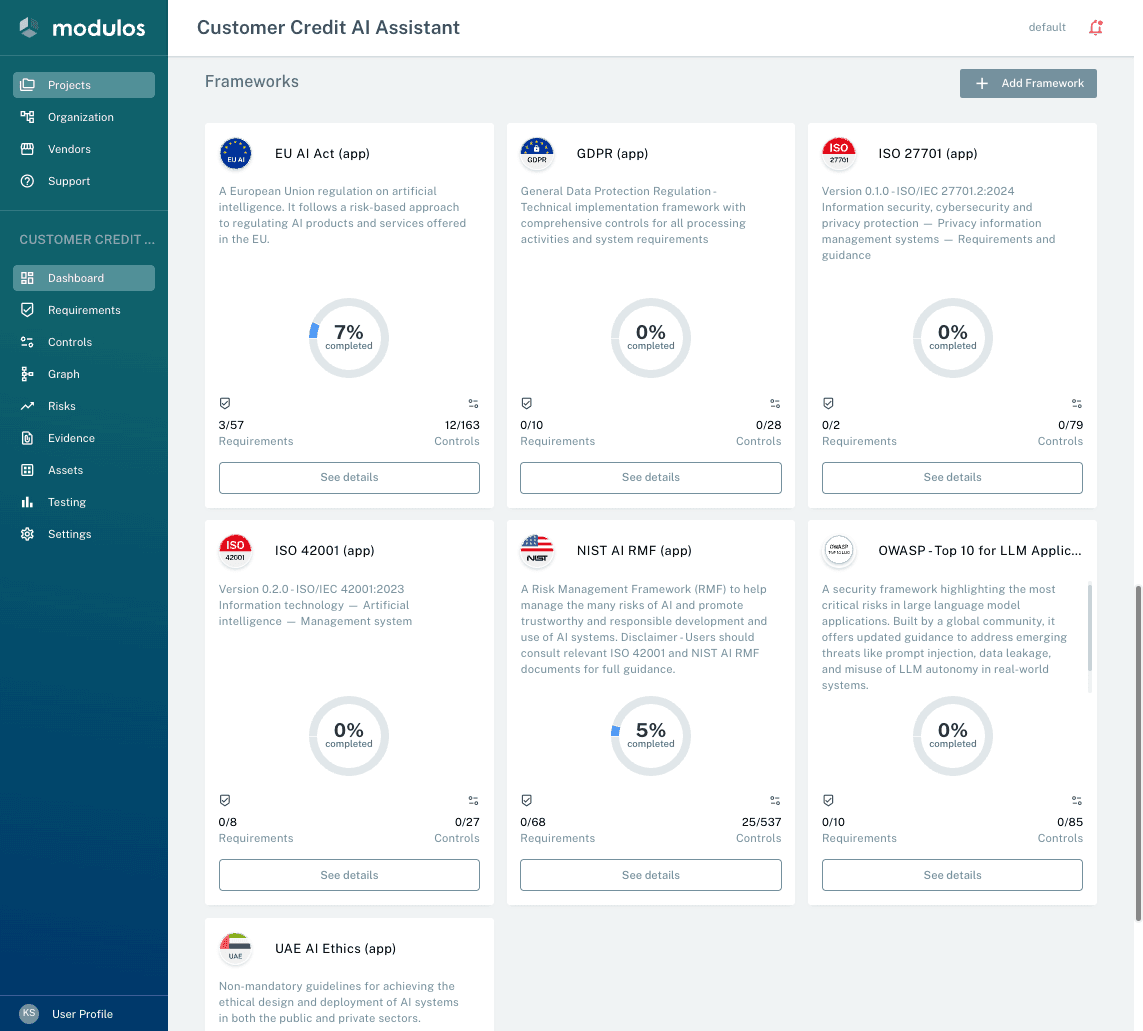
Manage governance, risk management, and compliance from a single platform, with AI agents that optimize your work.
Governance
Manage AI governance like an operating system
Project dashboards, AI lifecycle monitoring, accountability workflows, and complete traceability. Manage your entire AI portfolio from a single panel.
- Project and enterprise dashboards
- AI lifecycle monitoring
- Accountability and responsibility workflows
- Complete audit traceability
Penalties and Non-Compliance Risks
The EU AI Act provides a strict sanctions regime. The amount varies depending on the severity of the violation: from providing false information to implementing expressly prohibited AI practices.
For SMEs and startups, proportionate caps are provided that balance deterrent effect with business sustainability.
Penalty Details
Use of Prohibited AI Systems
Non-compliance with High-Risk Requirements
False or Incomplete Information to Authorities
Beyond financial penalties, reputational and operational impacts can be decisive: forced market withdrawal of systems, mandatory audits, operational disruptions, and significant loss of trust from customers, partners, and investors.
Frequently Asked Questions
The EU AI Act is the European Union's flagship legislation to regulate how AI systems are designed and deployed. It aims to protect fundamental rights, ensure safety, and promote innovation while creating a harmonized legal framework across the EU.
The EU AI Act requires AI system providers based in the EU to comply with the regulation. Additionally, the regulation also applies to providers and deployers outside the EU whose AI systems are used in the EU market. This means companies worldwide may need to be compliant if their AI products or services reach EU users.
The situation is similar to the global reach of the General Data Protection Regulation (GDPR). The AI Act applies to providers outside the EU if the output of their AI system is used in the EU. Non-EU deployers using AI systems in the EU are also covered. This extraterritorial reach means companies worldwide must assess their AI offerings for EU compliance.
On August 1, 2024, the EU AI Act officially entered into force. The regulation will be fully applicable by August 2027, with various provisions taking effect at different milestones: prohibitions for unacceptable risks (February 2025), GPAI obligations (August 2025), high-risk system requirements (August 2026-2027).
To be ready for the EU AI Act, companies must comply with the regulation's extensive requirements. Key steps include: conducting an AI systems inventory, classifying systems by risk level, implementing required documentation and risk management systems, ensuring data governance practices, and establishing human oversight mechanisms.
Under the EU AI Act, substantial modifications to an AI system can change your role from deployer to provider, triggering additional compliance obligations. Key changes that can reclassify you include: • Modifying core algorithms: Changes to the fundamental logic or algorithms of the AI system. • Retraining with new data: Using new datasets for training that substantially change the system's performance or behavior. • Integration with other systems: Changing how the AI system interacts with other hardware or software components. The consequences of being classified as a provider include increased responsibilities such as compliance with all provider obligations under the regulation, including conformity assessments, documentation requirements, and ongoing monitoring obligations.
What Our Customers Say
“At Adigital, we use Modulos as an evidence management system for our AI transparency and explainability certification – the first of its kind in Europe.”
Read more...

Justo Hidalgo
Chief AI Officer
Adigital
“The Modulos AI governance platform streamlined our process. Without it, we would have needed twice as much time to manually create control lists from ISO 42001 annexes.”
Read more...

Leif-Nissen Lundbaek
CEO & Co-Founder
Xayn
“Modulos is an essential platform for anyone who wants to make their sophisticated AI systems compliant. The platform's ability to bring together various stakeholders...”
Read more...

Mason Hiroto
Head of Consulting, Digital Transformation
SCSK
“Are you planning to develop an AI-based application for diagnosis or therapy and looking for valid guidance in the dynamic EU AI regulatory jungle?”
Read more...

Dr. Ursula Kramer
CEO
sanawork Gesundheitskommunikation

“Modulos is crucial to UniverseTBD's mission, integrating essential AI governance principles like ethics, transparency, and fairness into our AI exploration.”
Read more...

Dr. Ioana Ciuca
Universe TBD / ANU
Universe TBD
Prepare Your Organization for the AI Act
Request a personalized demo and discover how Modulos can turn your EU AI Act compliance into a competitive advantage.
Request a Demo© 2018-2026 Modulos.ai. All Rights Reserved