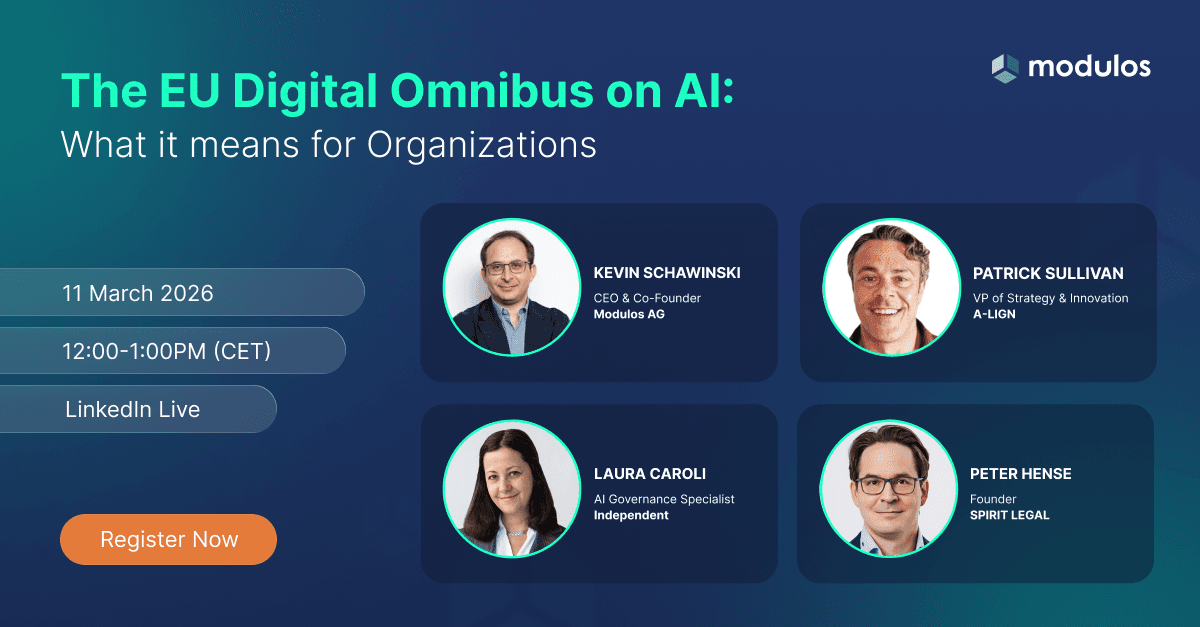
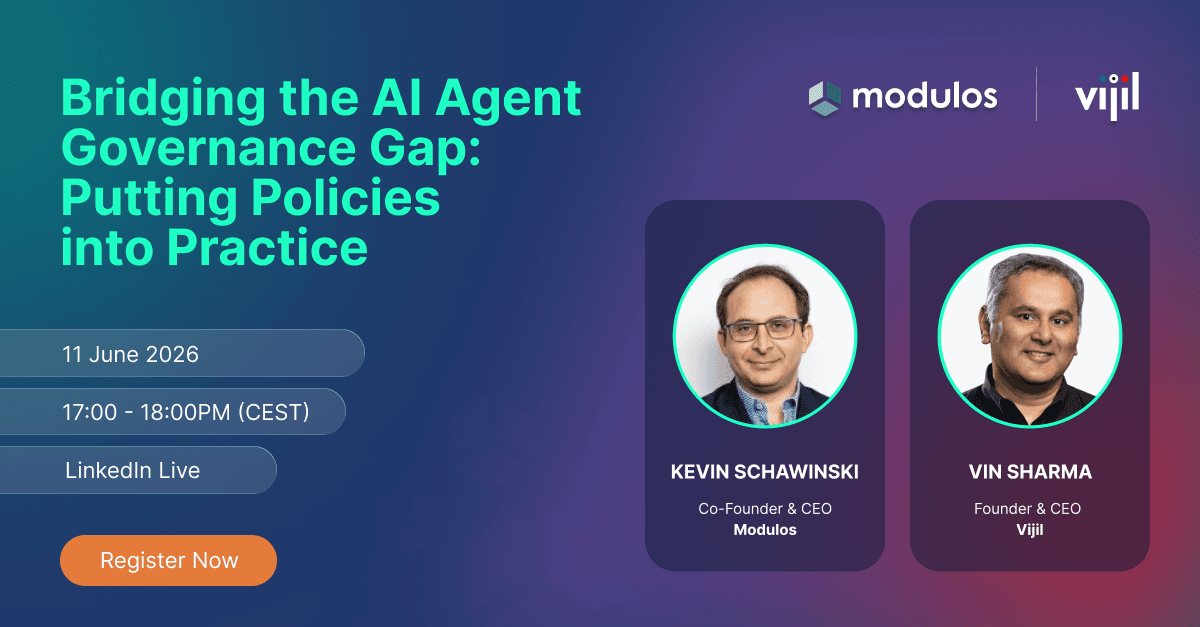
Bridging the AI Agent Governance Gap: Putting Policies into Practice
For organizations contending with AI agent sprawl and the gap between AI adoption and its governance, managing risk and exposure has become an urgent concern. While the EU AI Act’s provisions for continuous monitoring, risk-based oversight, and audit-ready evidence may still be on the horizon for many, most organizations already face a more immediate challenge: governance teams can define policies, but lack the tools to validate that AI systems actually comply, and continue to comply, with them.
Live stream starts
Thursday, June 11, 2026 at 05:00 PM
The stream will appear here automatically when we go live.
For organizations contending with AI agent sprawl and the gap between AI adoption and its governance, managing risk and exposure has become an urgent concern. While the EU AI Act’s provisions for continuous monitoring, risk-based oversight, and audit-ready evidence may still be on the horizon for many, most organizations already face a more immediate challenge: governance teams can define policies, but lack the tools to validate that AI systems actually comply, and continue to comply, with them.
Join Kevin Schawinski (CEO, Modulos) and Vin Sharma (Founder & CEO, Vijil) to explore how forward-thinking organizations are bridging that gap, unifying AI governance with automated system-level evaluation and runtime enforcement. This session covers what an integrated governance strategy looks like in practice, where most enterprises fall short, and how a closed-loop approach to policy definition, agent evaluation, and ongoing monitoring can turn regulatory obligation into a cross-functional model for responsible AI scaling.
What you will take away:
- Discovering and registering agents and AI systems: initiating the governance process by getting visibility on what’s running
- The policy gap: governance teams can define policies and risk tolerances, but have no mechanism to verify AI agents actually adhere to them
- Why manual validation doesn’t scale: it doesn’t replicate production conditions and produces no quantifiable evidence
- Why a quantifiable Trust Score matters: bridging the communication gap between engineering teams and legal, risk, and executive stakeholders
- Scoring across regulatory dimensions: security, robustness, fairness, privacy, ethics, and reliability
- Risk-based remediation: using risk quantification to prioritize fixes and make defensible deployment decisions
- The hidden organizational risk: compliance debt accumulates silently until an audit or incident exposes it
Want to Learn More About AI Governance?
Discover how Modulos can help your organization build compliant and trustworthy AI systems.