The Board Wants AI Everywhere
Problem
Here is a bind that many a CISO will recognize. The board has decided that AI goes into everything, and it wants this yesterday. That same board has not paused to ask what risk the decision creates, who owns it, or what happens when a customer-facing model fails in public. The security leader is left holding a mandate to accelerate and a duty to protect, with no shared language to connect the two.
One security leader at a large consumer brand described this pressure almost exactly. Management kept telling him to put AI into every product, and he could see the risk of a public, potentially catastrophic failure with complete clarity, yet he had no way to raise it in terms the board would act on. Flagging something as risky reads as obstruction. The board hears a brake when it has asked for an accelerator. The piece he was missing was a way to say yes to deployment and attach the mitigation in the same breath.
Solution
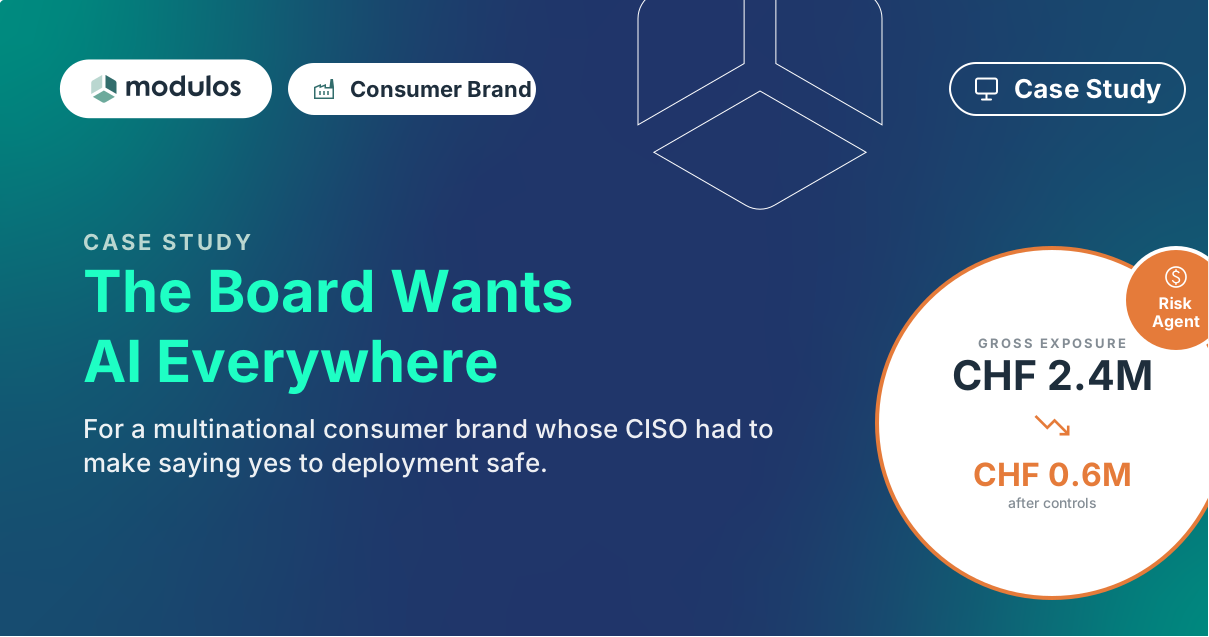
It turns out the way through this bind is to give the CISO a number. Most governance tools hand a board a heat map of high, medium, and low, which answers none of the questions a board actually asks. Modulos quantifies AI risk in money. Its Risk Agent, built on Fermi estimation, investigates the structural data in a project, audits the controls already in place to calculate a mitigation factor, and produces a defensible exposure figure in CHF, EUR, or USD with the full reasoning chain retained for the auditor. Risk stopped being a feeling the CISO carried alone and became a quantified, documented position the board could own alongside him: here is the exposure in francs, here are the controls reducing it, and here is the residual the board is choosing to accept.
That reframing changes the politics of the room. The CISO is no longer the person who blocks. He becomes the person who can put a number on what saying yes will cost and show exactly how that cost is contained, which is something a qualitative scorecard can never do. Deployment velocity and risk management stop pulling against each other, and the board moves fast with its eyes open, which is the only kind of fast that lasts.
I was being told to put AI into everything while being held responsible for whatever happened next. Modulos let me put a franc figure on the exposure and show the board the controls bringing it down, so the decision stayed theirs and the risk was finally something we could both see.
— Chief Information Security Officer, Global Consumer Brand