The EU's AI Content Labels: Which Icon, What to Disclose
The Commission published the official AI-content icons on 10 June 2026. Which of the three to use, what Article 50 makes you disclose, and by when.

On 10 June 2026 the European Commission, working through the AI Office, published a set of EU icons for labelling AI-generated content, releasing them as part of Section 2 of the new Code of Practice on Transparency of AI-Generated Content, and for once the regulator has shipped something a content team can pick up and use, namely three freely available icons, in SVG and PNG and four colour treatments, that mark an image, a video, a clip of audio or a passage of text as something an AI made or changed. The icons are the visible, shareable part of a larger obligation, and the rest of this post works through the part that matters in practice: which of the three fits a given piece of content, what the law actually requires you to disclose, whether the duty falls on you as a provider or as a deployer, and what has to be in place before it applies on 2 August 2026.
Two things are worth fixing in mind before the detail, because they shape every decision that follows. The icons themselves are optional, while the disclosure duty under Article 50 of the EU AI Act that they serve is mandatory, so an icon is a convenient instrument for compliance and never a substitute for it; and the date behind the duty is the one the digital omnibus confirmed when Parliament adopted it on 16 June, which makes the planning horizon both real and close.
The icons are part of a larger instrument, the Code of Practice on Transparency of AI-Generated Content, a voluntary code facilitated by the AI Office and published the same day, which is built in two halves: Section 1 sets out how providers should mark and make their systems' output detectable, and Section 2 sets out how deployers should label deepfakes and certain AI-generated text, with the icons sitting in Section 2 as a deployer's tool.
The three icons and when to use each
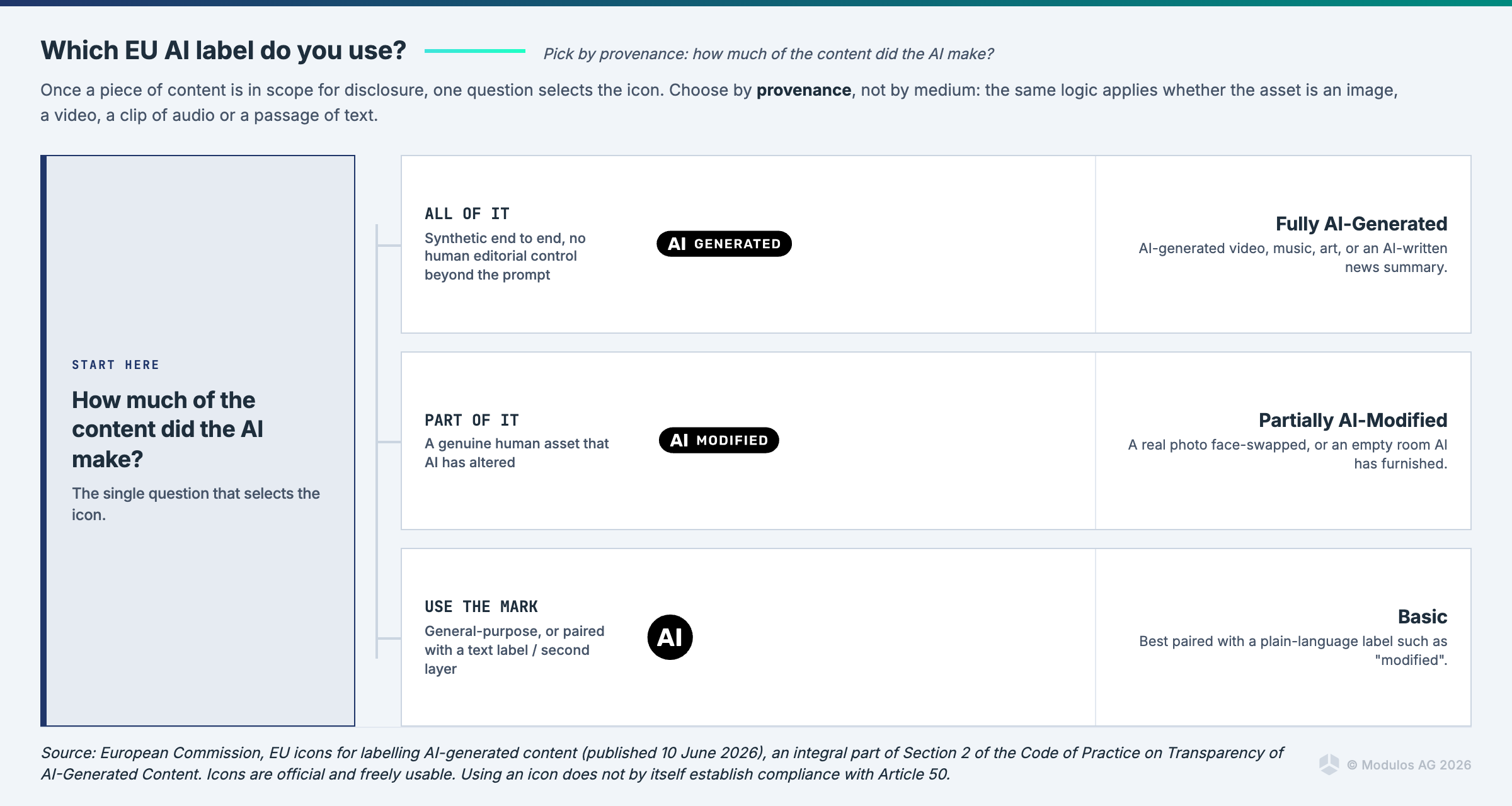
There are three icons, and choosing between them turns on a single question, which is how much of the content the AI is responsible for.
| Icon | When to use it | Example |
|---|---|---|
| Basic | The general-purpose marker: AI was involved in creating a deepfake or published text, or you are pairing the mark with a custom text label or an interactive second layer | A deepfake video carrying the text label "voices generated with" followed by the basic icon |
| Fully AI-Generated | The entire piece is generated by AI, with no human-created elements and no human editorial control beyond the prompt | A fully AI-generated video of a politician or a fictional event, AI-composed music or art, an AI-written news summary |
| Partially AI-Modified | Pre-existing, human-made content was partially changed by AI, turning it into a deepfake or into public-interest text | A real photograph with a politician's face swapped in, or an authentic photo of an empty apartment that AI has furnished |
The practical rule that falls out of the table is to choose by provenance, so that content which is synthetic from end to end takes the Fully AI-Generated icon, a genuine human asset that AI has altered takes the Partially AI-Modified icon, and the Basic icon serves as the general-purpose mark, which the Commission's own user-testing suggests works best when it sits beside a short plain-language label such as "modified". The icons come in black, white and two half-transparent treatments, in both SVG and PNG, and they are free to download, without any attribution to the Commission or the AI Office, from the Commission's EU icons page, which is the single link worth putting in front of whoever owns your content pipeline.
What you must disclose, and why the icon alone is not compliance
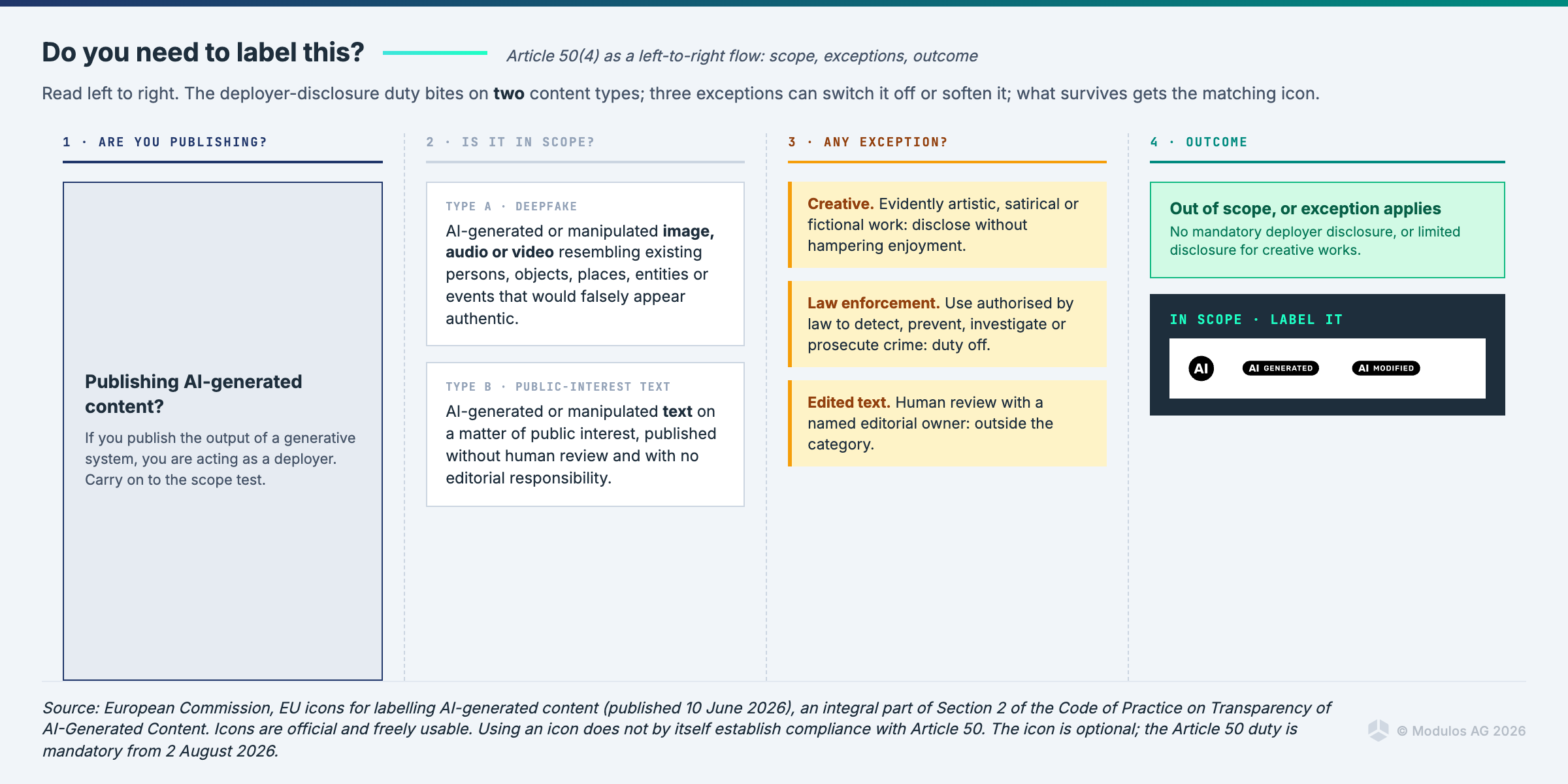
The icons serve one specific obligation, Article 50(4) of the EU AI Act, which is the duty that falls on deployers, and it covers two specific kinds of content while leaving the rest of what an AI touches outside its scope. The first is the deep fake, meaning AI-generated or manipulated image, audio or video that resembles existing persons, objects, places, entities or events and that would falsely appear to a person to be authentic or truthful; the second is AI-generated or manipulated text published to inform the public on matters of public interest, where that text has not undergone human review or editorial control and no legal or natural person has assumed editorial responsibility for it. Everything outside those two categories, which is the great mass of ordinary AI-assisted work, carries no mandatory deployer disclosure under Article 50(4).
The point the Commission makes in plain words, and the one most worth carrying into a content review, is that the icon is optional while the obligation is mandatory, and that applying an icon "does not establish legal compliance by itself". A deployer remains responsible for ensuring the disclosure actually meets Article 50, so a label that is buried, easily missed, or stripped out when the content is reshared can leave you both icon-bearing and non-compliant. The sensible first move is therefore to inventory the content you put in front of people and sort it into three buckets, the deepfakes, the AI-generated public-interest text, and everything else, because the first two carry the duty and the third does not; the test then becomes four questions, whether the content is a deepfake, whether it is AI-generated text on a matter of public interest published without human review or editorial responsibility, whether one of the exceptions covered in the next section applies, and, if it remains in scope, which of the three icons matches its provenance.
Provider or deployer, and the 2 August 2026 clock
Article 50 divides the work between two roles, and most organisations occupy both at once depending on the system in front of them. A provider, the party that develops an AI system and places it on the market or puts it into service under its own name or trademark, owes the duty in Article 50(2), which is to mark the system's output in a machine-readable format and to make it detectable as artificially generated or manipulated, the world of watermarks and embedded metadata; a deployer, the party that uses such a system to produce content, owes the duty in Article 50(4), the visible disclosure that the icons serve; and over both sits Article 50(5), the horizontal requirement that whatever disclosure you make be clear and distinguishable and provided at the latest when a person first encounters the content.
The clock for all of this is 2 August 2026, the general application date that the digital omnibus, adopted by Parliament on 16 June, left in place even as it pushed the high-risk deadlines out to 2027 and 2028, though the omnibus did move one neighbouring date by granting systems already on the market before 2 August 2026 a transition until 2 December 2026 to bring their machine-readable marking into line. The operational consequence is that you should decide, system by system, whether you are acting as provider or as deployer, because if you build or badge the model you are marking under Article 50(2), if you merely publish its output you are labelling under Article 50(4), and if you do both, as a great many enterprises will, you owe both.
The exceptions that change what you owe
Three exceptions narrow the deployer's duty, and each turns on a precise trigger that is worth getting right. Where a deepfake forms part of an evidently artistic, creative, satirical or fictional work, the obligation softens to a disclosure made in a manner that does not hamper the display or enjoyment of the work, so the mark may sit in the credits, an information panel or another appropriate place instead of being stamped across the frame; where the use is authorised by law to detect, prevent, investigate or prosecute a criminal offence, the disclosure duty falls away entirely; and where AI-generated text has been through a process of human review or editorial control, with a natural or legal person holding editorial responsibility for what is published, that text sits outside the mandatory-disclosure category.
The third exception is the one most enterprises can actually engineer around, because it depends on a process step they control: a deliberate human review stage, with a named owner of editorial responsibility, lifts AI-generated or manipulated public-interest text out of the disclosure obligation, which is a decision a newsroom or a content team can take on purpose and document, instead of discovering after publication that a piece needed a label it never carried.
How to display the label so it counts
The legal baseline is set by Article 50(5), which requires that whatever disclosure you make be clear, distinguishable and provided at the latest when a person is first exposed to the content. Section 2 of the code then adds the detailed placement specifications that signatories commit to implement, and those read closer to engineering requirements than to design suggestions: the mark should sit where no intervening overlay element covers it, and, except for creative works, it should be embedded directly into the content so that it survives when the asset is reshared or downloaded, unless an equivalent alternative such as a user-interface overlay is used in its place. A label that disappears the moment a video is reposted to another platform fails the test that matters, which is precisely why the durable home for it is inside the asset instead of around it.
The code also asks for accessibility measures worth building in from the start: a clearly visible size, plain-language labels that avoid jargon and any abbreviation other than "AI", alt text or ARIA labels so that assistive technologies announce the content as AI-generated, and enough on-screen time for a reader who needs longer to take it in. The single way to think about the label is as a feature of the content pipeline, applied at the point of generation or publication, persisted through every downstream copy, and exposed to the tools that real audiences actually use.
How Modulos marks AI-generated content
Marking AI-generated content is established practice at Modulos, which has always done it on the platform, and the EU icons mainly give that practice a shared vocabulary to standardise on, a transition we are now making across our visual language. We have also added the Partially AI-Modified icon to our own website, in a pending pull request as this post goes out, to declare that parts of the site were modified with AI, which is the honest description of human-made pages that AI has had a hand in. Ordinary website content is neither a deepfake nor AI-generated public-interest text, so the obligation does not strictly reach us there, and we have applied the label anyway, on the simple view that disclosure a little above the legal floor is a cheap and durable way to earn trust.
That is the practical lesson sitting underneath the icons, because the obligation under Article 50 is the floor, the icons are the shared language laid on top of it, and the organisations that mark consistently and slightly more generously than the letter demands are the ones that will not be improvising when the August date arrives and the first questions come from a market surveillance authority. The official icons are free to take and use today, from the Commission's EU icons page, and the sensible programme is to inventory your content against the deepfake and public-interest-text categories, decide where you stand as provider and where as deployer, and wire the right icon into your pipeline so that it is embedded, persistent and accessible well before 2 August 2026.
Request a demo and we will walk through how Modulos maps your AI inventory to the Article 50 duties and turns the required disclosure into a content and governance workflow that holds alongside ISO 42001, the NIST AI RMF, NIS2 and DORA.
Frequently asked questions
Do I have to use the EU icons? No; the icons are optional and you may meet Article 50 by other means, but the disclosure obligation is mandatory from 2 August 2026, and because using an icon does not by itself establish compliance, the label still has to satisfy the clarity, placement and persistence requirements.
Who has to label, the provider or the deployer? Both: the provider marks the system's output in a machine-readable, detectable format under Article 50(2), the deployer makes the visible disclosure under Article 50(4) that the icons serve, and an organisation that both builds and uses a generative system carries both duties.
When do the EU AI Act labelling rules apply? The rules apply from 2 August 2026, with a transition to 2 December 2026 for the machine-readable marking duty on systems already on the market before that date.
What content is exempt from AI labelling? Content outside the deepfake and AI-generated public-interest-text categories is exempt, and the duty is further softened for evidently artistic, creative, satirical or fictional works, switched off where the use is authorised by law to detect, prevent, investigate or prosecute criminal offences, and inapplicable to AI-generated text that has had human review with a named editorial owner.
Should we sign the Code of Practice? Signing is voluntary, but it changes how you prove compliance: following a positive adequacy assessment by the Commission and the AI Board, now under way, a signatory can rely on the Code's measures to show it meets Article 50, with a lighter burden and predictability across every Member State, whereas an organisation that complies by another route must show market surveillance authorities that its measures are adequate; the code does not replace the AI Act or the Commission's forthcoming Article 50 guidelines.